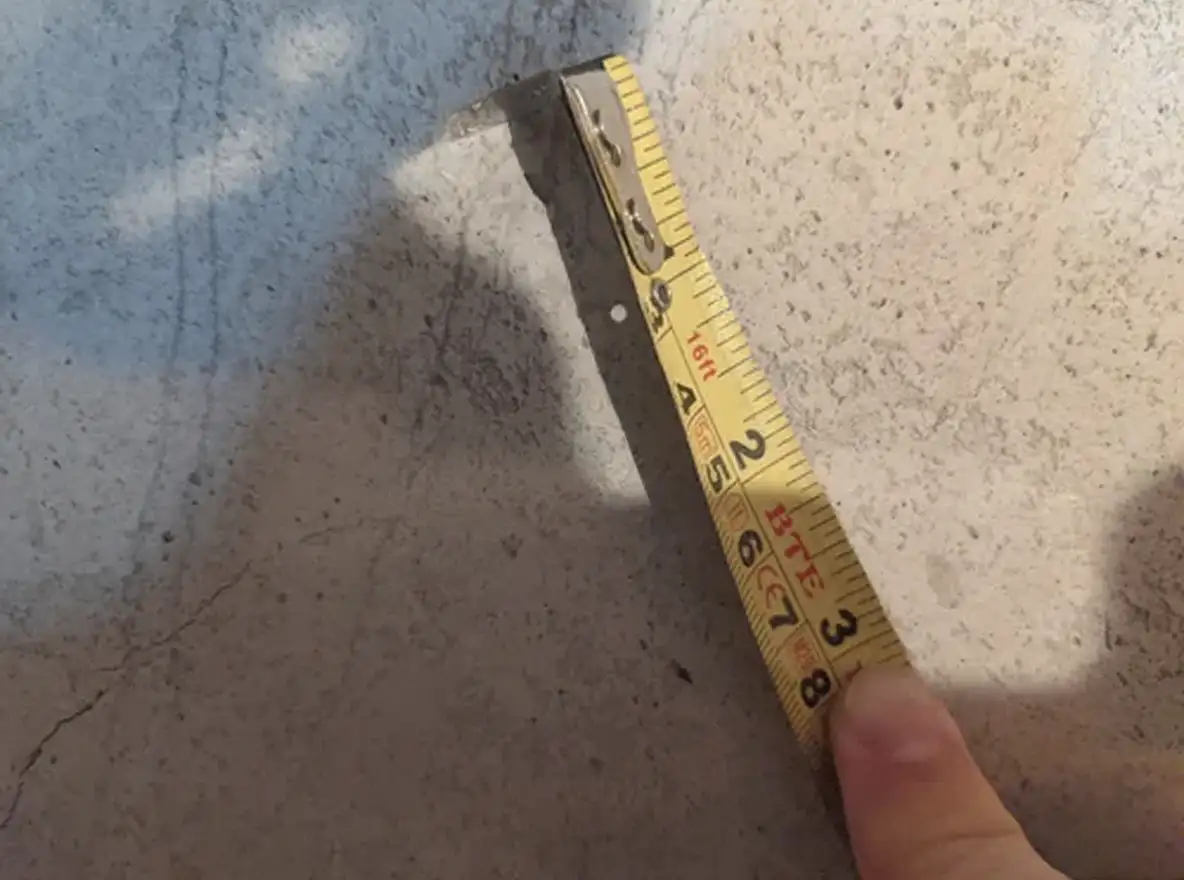
Diagonal cracks in foundation walls are a direct indicator of differential settlement — a condition where one section of your foundation is sinking faster than the section next to it. Unlike vertical cracks, which are often harmless curing artifacts, diagonal cracks almost always signal active structural movement. The roughly 45-degree angle of these cracks is not random. It follows the path of maximum shear stress through the wall material, making diagonal cracks one of the most structurally informative crack types a homeowner can identify.
The severity of a diagonal crack depends on its width, its rate of change, and the settlement gradient it represents. A hairline diagonal crack at a window corner may reflect minor, localized stress. A 1/4-inch diagonal crack spanning from the footing to the top of the wall reflects significant uneven bearing pressure across the foundation footprint. Both tell the same story — differential movement — but at very different magnitudes. This page covers how to read that story accurately.
What Does a Diagonal Foundation Crack Look Like?
A diagonal crack runs at an angle between 30 and 60 degrees from horizontal, most commonly near 45 degrees, and typically originates at a stress concentration point. The most common origination points are the corners of window openings, door openings, pipe penetrations, and the junction where a wall meets a perpendicular wall. The crack radiates outward from these corners because the geometry of the opening concentrates the stress of differential movement at those points.
In poured concrete walls, diagonal cracks cut directly through the concrete at a clean angle. The crack faces are usually sharp-edged and may show slight offset where one side has dropped relative to the other. In concrete block walls, diagonal cracks tend to follow the mortar joints in a stair-step pattern that approximates a diagonal line. The underlying force is the same — differential settlement — but the failure path differs based on the wall material.
Corner crack propagation often creates a mirrored pattern. A window with settlement occurring beneath its left side may develop diagonal cracks from both the lower-left corner (angling down and left) and the upper-right corner (angling up and right). This X-pattern of paired diagonal cracks framing an opening is a strong diagnostic indicator of differential settlement centered on that section of the wall.
Diagonal cracks are wider at the end closest to the settling zone and narrower at the opposite end. The taper reveals which direction the movement is occurring. If a diagonal crack is widest at the bottom-left and narrows toward the upper-right, the foundation is settling on the left side. Reading the taper direction is one of the most useful diagnostic skills a homeowner can develop for understanding their foundation's behavior.
Why Do Diagonal Cracks Indicate Differential Settlement?
Differential settlement occurs when the soil beneath one section of a foundation compresses, erodes, or shrinks more than the soil beneath an adjacent section, creating uneven bearing pressure across the footprint. Foundations are designed to distribute building loads uniformly across the footing. When the supporting soil changes unevenly — one side dries out while the other stays moist, or one corner sits on fill soil that was poorly compacted — the uniform load distribution fails. Sections with less support settle; sections with adequate support hold position.
Kansas City's seasonal rainfall variation — 5.7 inches in May dropping to 1.5 inches in January — creates the moisture differential that drives uneven clay expansion across the metro. The south-facing side of a home loses soil moisture faster than the north-facing side. Downspout discharge zones stay wetter than areas far from the roof edge. Landscaping irrigation creates moist zones adjacent to dry zones. Each of these moisture boundaries creates a settlement gradient — a zone where the soil support changes from adequate to inadequate over a short horizontal distance.
Diagonal cracks have no benign explanation. Unlike vertical cracks, which are often harmless curing artifacts, a diagonal crack formed because two sections of the foundation moved differently — and that movement imposed shear stress on the wall.The 45-degree crack angle corresponds to the maximum shear stress plane in a wall subjected to differential settlement. When one section of a wall drops while the adjacent section remains stationary, the wall experiences a combination of bending and shearing forces. Structural mechanics dictates that the maximum shear stress in this loading condition occurs at approximately 45 degrees from the principal stress axes. The crack follows this stress field because concrete and masonry fail along the plane of highest stress. The soil science behind the settlement process is covered in detail on the soil science page.
Point load failure — where a concentrated load bears on a section of footing with inadequate soil support — creates localized diagonal cracks. A steel beam pocket, a load-bearing column footing, or a chimney footing that sits on soil with lower bearing capacity than the surrounding foundation soil will settle independently. The diagonal cracks radiating from the point load location tell engineers exactly where the bearing capacity has been lost.
How Serious Are Diagonal Foundation Cracks?
Diagonal cracks are almost always structural rather than cosmetic, because the force that creates them — differential settlement — is a structural phenomenon. Vertical cracks have a benign explanation (curing shrinkage) that accounts for the majority of cases. Diagonal cracks have no equivalent benign explanation. A diagonal crack formed because two sections of the foundation moved differently, and that movement imposed shear stress on the wall. The question is not whether the crack is structural — it is — but whether the movement is ongoing or has stabilized.
Angular distortion — the ratio of differential settlement to the horizontal distance between the settling and stable sections — is the engineering metric for severity. A 1/2-inch settlement difference over a 20-foot span produces a different structural outcome than 1/2-inch over a 4-foot span. The wider the diagonal crack relative to the span of wall it crosses, the higher the angular distortion and the more significant the structural concern.
Diagonal cracks under 1/8 inch that have been stable through a full seasonal cycle may represent settlement that has reached equilibrium. Soil beneath a footing can compress to a new stable density after the initial load is applied, and the settlement stops permanently. The diagonal crack remains as a record of that past movement but poses no ongoing structural risk if it stops progressing. Quarterly monitoring through spring, summer, fall, and winter confirms whether equilibrium has been reached.
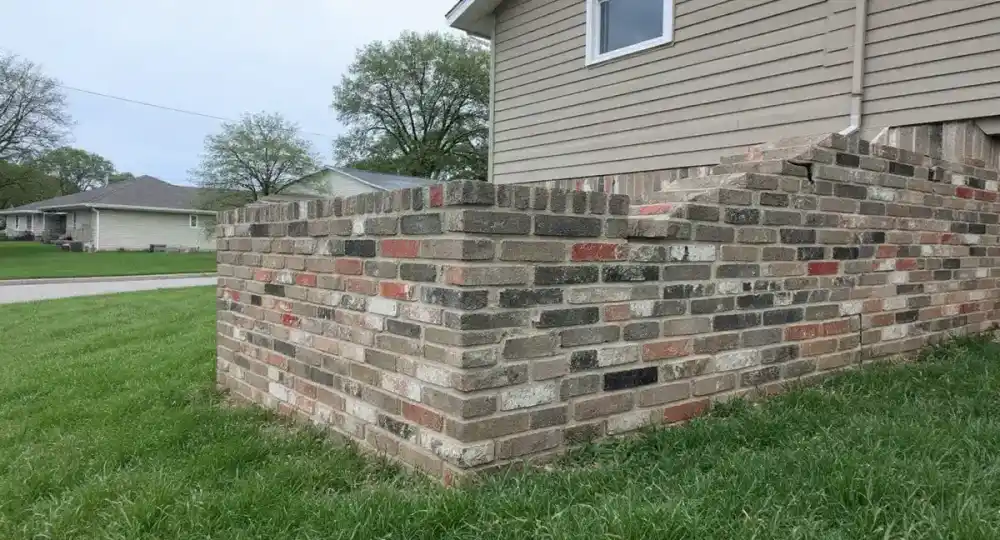
Diagonal cracks over 1/4 inch, cracks that are actively widening, or cracks accompanied by companion symptoms elsewhere in the home indicate progressive differential settlement that requires professional evaluation. Progressive settlement does not self-correct. The shrink-swell cycle in expansive clay ratchets the movement incrementally worse with each season, meaning the diagonal crack will be wider next year than it is today. Early evaluation is consistently less disruptive and less expensive than delayed evaluation.
What Other Symptoms Accompany Diagonal Cracks?
Diagonal cracks from differential settlement rarely appear in isolation — the same uneven movement that cracks the foundation wall produces visible effects throughout the structure above. The floor framing system that sits on top of the settling wall section tilts, the wall framing above tilts with it, and the connections between framing members are stressed in ways they were not designed for. The resulting symptom pattern across the home provides strong confirmation of differential settlement when it aligns with the location and direction of the diagonal crack.
Look for these companion symptoms on the same side of the home as the diagonal crack:
- Doors that stick at the top on one side and have a gap at the top on the opposite side — the frame has racked into a parallelogram shape from the differential movement
- Floors that slope toward the settling corner, often detectable by placing a marble on a hard floor surface
- Drywall cracks above door and window frames on the main level — these diagonal drywall cracks are the upper-story equivalent of the foundation diagonal crack below
- Gaps between the wall and ceiling on the side opposite the settlement — as one side drops, the other side effectively lifts relative to the settling side
- Chimney separating from the house if the chimney footing is settling independently of the main foundation
The more companion symptoms you find, the more confident the diagnosis of active differential settlement becomes. A single diagonal crack with no other symptoms could be a localized stress artifact. A diagonal crack plus sticking doors plus a sloping floor plus drywall cracks on the same side of the house is a clear differential settlement pattern requiring professional assessment.
What Action Does Finding a Diagonal Foundation Crack Require?
Document the crack thoroughly before doing anything else — the information you record now becomes the baseline for every future decision about this crack. Photograph the full crack from end to end with a ruler or coin for scale. Measure the width at the widest point and at the narrowest point. Note the location on the wall relative to openings, corners, and the footing. Record the date. Mark both endpoints with short dated pencil lines perpendicular to the crack direction. This takes fifteen minutes and creates an objective record that eliminates guesswork later.
Survey the rest of the home for the companion symptoms listed above, and document those too. Check every door on the floor above the crack for sticking or latching problems. Walk the floors for slope. Look at wall-ceiling joints for gaps. Check drywall above windows and doors for cracks. Each finding either strengthens or weakens the differential settlement interpretation and helps a professional make an accurate assessment faster.
For diagonal cracks under 1/8 inch with no companion symptoms, establish a quarterly monitoring schedule aligned with seasonal transitions. Check in March (post-freeze-thaw), June (peak spring moisture), September (end of summer drought), and December (pre-freeze). Des Moines homeowners should add a January check to capture the deeper frost cycle — the 42-inch frost depth in central Iowa creates more pronounced freeze-thaw movement than Kansas City's 36-inch frost depth. Twelve months of stable measurements through all four seasons provides reasonable confidence that the settlement has equilibrated.
For diagonal cracks over 1/8 inch, cracks showing active growth, or cracks accompanied by multiple companion symptoms, schedule a professional evaluation rather than monitoring. A structural engineer can measure the angular distortion, assess whether the movement is active or arrested, identify the soil condition driving the differential settlement, and recommend a repair approach matched to the specific failure mode. An independent engineer has no financial interest in selling you a repair, which makes their diagnosis more reliable than a contractor's free inspection.
Diagonal cracks are almost always structural. Document the crack width at multiple points, note which end is wider to determine the direction of settlement, survey the home for companion symptoms, and schedule a structural engineer evaluation if the crack exceeds 1/8 inch or is actively growing.
For information on repair costs and financing options, see the cost and economics page. Repair method selection depends entirely on the type and extent of movement identified during the professional evaluation — there is no one-size-fits-all solution for differential settlement.
Which Season Drives Diagonal Crack Progression Most in KC and Des Moines?
Diagonal cracks are the signature of differential settlement, and differential settlement in Kansas City accelerates during the summer-fall contraction phase. As Wymore-Ladoga clay dries from August through October, it contracts unevenly across the foundation footprint — south-facing and west-facing walls lose moisture faster than north-facing sides. The differential drying creates differential settlement: the south corner of a home may drop 1/16 inch more than the north corner in a single dry season. Over five or ten seasons, those increments accumulate into visible diagonal cracks at windows and door corners.
The crack typically does not grow at a constant rate — it advances in steps, adding width or length during each contraction cycle. A diagonal crack that measured 1/8 inch in the spring of one year may measure 3/16 inch by the following fall, having progressed through two full annual cycles. This stepping pattern means that short-term monitoring (a single measurement) can miss active progression if it's taken between active cycles. Measuring at the end of summer (September) in Kansas City and at the end of spring (May) in Des Moines captures peak movement.
Des Moines diagonal cracks driven by hydrostatic uplift respond to the spring pressure peak. Floor slab cracking and corner diagonal cracks in poured concrete Des Moines basements are most likely to advance in April-May, when saturated glacial till applies simultaneous upward pressure against the slab and lateral pressure against the walls. If a Des Moines diagonal crack has grown since the previous year, the growth likely occurred during this spring window.
Which Repair Methods Address Differential Settlement and Diagonal Cracks?
Diagonal cracks indicate differential settlement, so the repair targets the settling footing section rather than the crack itself. Push piers are the standard repair for residential homes on Kansas City's limestone bedrock: steel tubes hydraulically driven 15 to 25 feet below grade reach stable bearing strata, transfer the home's weight off the settling clay, and can lift the settled section back toward its original position. Kansas City's shallow limestone bedrock makes push pier installation efficient and predictable.
In Des Moines, where glacial till extends 45 to 60 feet and bedrock is not an accessible end-bearing target, helical piers driven to adequate torque in dense till layers are more commonly used. The torque-monitored installation confirms load capacity without requiring bedrock contact. After settlement is stopped by piering, diagonal cracks can be sealed with epoxy crack injection for a rigid structural bond, or left monitored to confirm stability before cosmetic repair. The helical vs. push pier comparison explains which system fits each structural scenario.
Are Diagonal Cracks More Common in Kansas City or Des Moines — and Why?
Diagonal cracks are significantly more prevalent in Kansas City than in Des Moines, for a direct geological reason: differential settlement driven by KC's shrink-swell clay is far more common than Des Moines' predominantly lateral-pressure failure mode.
In Kansas City, diagonal cracks are one of the two most common structural crack types alongside stair-step cracks. The Wymore-Ladoga clay contracts unevenly across the foundation footprint — south-facing and west-facing walls dry faster than north-facing walls, creating moisture differentials that produce differential settlement. One corner drops 1/16 inch more than another. Over five or ten seasons, those increments accumulate. The tension from this differential movement propagates as a 45-degree crack from structural weak points like window and door corners. KC's dense pre-1970 housing stock, especially the 1940s-60s Cape Cods and ranches, produces thousands of diagonal crack cases annually.
In Des Moines, diagonal cracks appear less frequently but with a different pattern. Rather than the 45-degree window-corner crack common in KC's block and poured-concrete homes, Des Moines diagonal cracks more often reflect localized settlement from differential water table conditions — one corner of a foundation sitting closer to a drainage corridor than another. Diagonal cracks in Des Moines homes warrant the same evaluation priority as in Kansas City but are more likely to be part of a pattern that also includes horizontal cracking and wall bowing.
How to Track Diagonal Foundation Cracks Between Professional Evaluations
Diagonal cracks are among the most reliably documentable crack types because they follow a clear geometric path with identifiable endpoints. The monitoring protocol is straightforward and takes under 10 minutes per observation.
Mark both crack endpoints with perpendicular pencil lines and the date. Diagonal cracks typically originate at the corner of a window or door opening and radiate outward toward the wall corner or the top of the foundation. Mark the end farthest from the opening — that endpoint moves when the crack extends.
Measure crack width at three points: at the origin (widest, typically at the opening corner), at the midpoint, and at the tip. The width progression along the crack length reveals the direction of movement: if the crack is widest at the origin and tapers to hairline at the tip, settlement is concentrated at the opening corner and diminishes with distance.
Note the direction of taper. A diagonal crack that is wider at the bottom than at the top indicates the bottom section of the foundation is dropping while the upper section remains stable — footing undermining. Wider at the top indicates upper wall movement from an attached structure (chimney, porch) pulling away while the footing holds.
Monitoring calendar for Kansas City: September is the highest-value observation point — peak clay contraction has occurred and any settlement from the current year's drought cycle has accumulated. March captures the spring baseline before the next expansion cycle begins.
What Can Homeowners Do About Diagonal Foundation Cracks?
Like stair-step cracks, diagonal cracks are always structural indicators — they confirm differential settlement has occurred. DIY work is diagnostic and preventive, not repair.
Appropriate homeowner actions
- Establish the monitoring baseline immediately: dated photos with ruler for scale, endpoint marks, width measurements at three points.
- Check drainage at the settling corner. Diagonal cracks from a specific corner often follow downspout discharge or grade problems at that corner — the most common preventable cause of localized differential settlement. Correcting the drainage does not reverse existing settlement but may stop additional cycles.
- Document companion symptoms. Sticking doors, floor slope, drywall cracks above the same door or window — these confirm active structural movement across the home and strengthen the case for prompt professional evaluation.
Evaluation thresholds
- Any diagonal crack wider than 1/8 inch warrants professional evaluation, not just monitoring
- Any diagonal crack that grew between two observations, regardless of current width
- Diagonal crack + companion symptoms anywhere in the home = evaluation, not monitoring
- Diagonal crack wider at the base than the top = footing undermining indicator, evaluation needed
Frequently Asked Questions About Diagonal Foundation Cracks
- What's the difference between foundation settlement and heave?
- Settlement occurs when soil beneath the foundation compresses or washes away, causing the structure to sink. Heave occurs when soil expands — typically from moisture absorption in clay — and pushes the foundation upward. Settlement pulls the foundation down in specific zones, while heave lifts it unevenly from below. Both produce diagonal cracks because both create differential movement, but the repair approach differs. Settlement is corrected with piering systems that bypass unstable soil. Heave is managed by controlling soil moisture.
- How does frost depth affect foundations in the Midwest?
- Kansas City's frost depth reaches 36 inches, and Des Moines' reaches 42 inches. Foundation footings must sit below these depths to avoid frost heave — the upward force created when soil moisture freezes and expands. If a footing is too shallow, annual freeze-thaw cycles lift one section of the foundation each winter and drop it each spring, creating the kind of differential movement that produces diagonal cracks. Midwest building codes require footings below the local frost line for this reason.
- What time of year is worst for foundation problems in Kansas City?
- Late summer through early fall is the highest-risk period. Kansas City's rainfall drops from 5.7 inches in May to around 3 inches in August, causing expansive clay soil to dry and shrink rapidly. The soil contraction pulls support away from footings, allowing settlement. When fall rains return, the soil re-expands unevenly, and the foundation does not return to its original position. Each annual cycle ratchets the settlement incrementally worse.
- Can I finance foundation repair?
- Most foundation repair contractors offer financing plans, and several third-party home improvement lenders specialize in foundation work. FHA Title I loans cover structural home improvements up to $25,000 without requiring home equity. Some homeowners use home equity lines of credit. The key consideration is that foundation problems are progressive — the cost of repair generally increases with delay, so financing a timely repair is typically less expensive than paying cash for a larger repair later. See the cost and economics page for more detail.
- How long does foundation repair last?
- Steel push piers and helical piers, when properly installed to load-bearing bedrock or competent strata, are designed for permanent stabilization — manufacturers typically offer 25-year to lifetime transferable warranties. Carbon fiber wall reinforcement is similarly permanent when the wall is stabilized before excessive deflection. Polyurethane foam injection for slab lifting lasts 10 to 15 years or longer depending on the underlying soil stability. The longevity of any repair depends on correctly diagnosing and addressing the root soil condition.