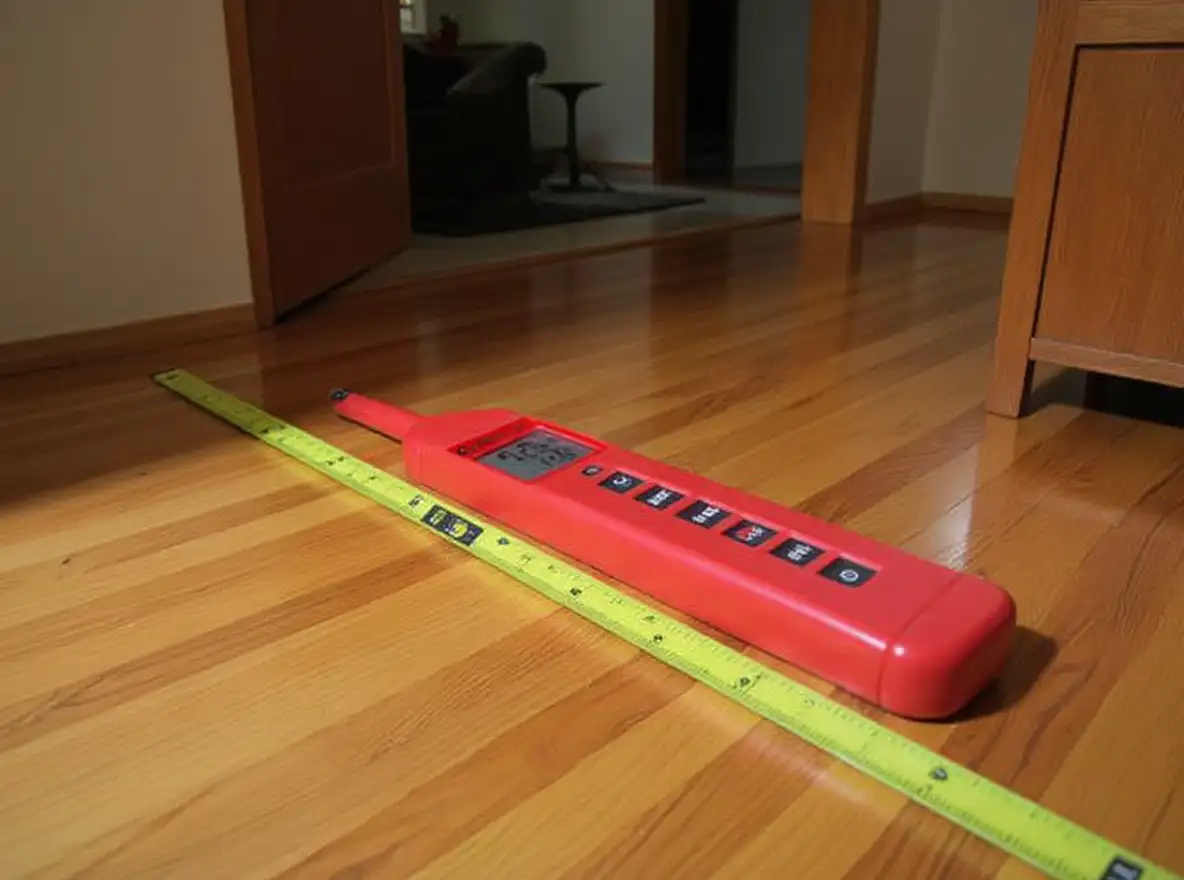
Sloping floors are almost always caused by foundation settlement — not by failed floor joists, subfloor deterioration, or structural framing defects. When one section of a foundation sinks lower than another, the floor system above tilts. The slope you feel underfoot is the visible expression of differential elevation change happening at the foundation level, sometimes inches below grade. Floor slope measurement is one of the most reliable ways to assess whether your foundation has moved and, critically, how much it has moved relative to its original position.
A floor that slopes toward the center of the home typically indicates settling interior support columns or a sinking beam. A floor that slopes toward an exterior wall suggests perimeter footing settlement. The direction and magnitude of the slope tell a diagnostic story that helps engineers pinpoint which part of the foundation has moved. Before assuming your floor structure has failed, check whether foundation settlement is driving the problem from below.
What Does a Sloping Floor Look and Feel Like?
A sloping floor creates the sensation of walking slightly uphill or downhill as you cross a room, and the effect is most noticeable in open spaces without furniture to mask it. In mild cases, you may not consciously register the slope but notice that a desk chair rolls toward one wall or a ball placed on the floor drifts in a consistent direction. In more pronounced cases, you can feel the tilt in your ankles and balance, especially when walking in socks on a hardwood or tile surface.
Visual indicators of floor slope include gaps beneath baseboards on the high side of the room and compressed or buckling baseboard on the low side. Furniture may rock unevenly. Cabinet doors in the kitchen may swing open on their own. Tile floors may develop cracked grout lines or lifted edges where the substrate has changed plane. Hardwood floors may show gaps between boards on the high side and compression ridges on the low side.
Sloping floors are almost always caused by foundation settlement, not by failed floor joists or subfloor deterioration. The slope you feel underfoot is the visible expression of differential elevation change happening at the foundation level.The classic marble test provides a quick visual confirmation of floor slope. Place a marble or small ball on the floor and observe its behavior. On a level surface, the marble stays put. On a sloped surface, it rolls toward the low point. While informal, this test reveals the slope direction and approximate low point — information that helps you understand which section of the foundation has settled. Repeat the test in multiple rooms to map the settlement gradient across the home's footprint.
Why Do Floors Start Sloping in Midwest Homes?
Floor slope develops when foundation settlement is uneven — one section sinks more than another, tilting the floor system above it. Uniform settlement (the entire foundation sinking equally) does not produce slope because the floor stays level relative to itself. Differential settlement is the mechanism, and it occurs when soil conditions vary beneath different parts of the foundation or when moisture levels differ from one side of the home to the other.
Homes built in the 1940s through 1960s — representing 30.72% of the Kansas City housing stock — on Wymore-Ladoga clay commonly develop progressive floor slopes as decades of shrink-swell cycling advance differential settlement. These older homes were built before modern soil testing and foundation engineering practices became standard. Their footings are often undersized for the soil conditions, and decades of seasonal clay expansion and contraction have slowly driven uneven settlement. The soil science page details how the shrink-swell cycle generates the forces that drive this movement.
Plumbing leaks beneath a slab or near a footing create localized soil erosion that accelerates settlement in one area. A slow leak from a supply line or drain pipe softens and washes away the bearing soil beneath a specific section of the foundation. The affected section settles while the rest of the foundation stays in place. Plumbing-related settlement can produce dramatic floor slopes over relatively short timeframes — months rather than decades.
Large trees near foundations draw moisture from the soil through root uptake, creating localized shrinkage zones that cause differential settlement. A mature oak or maple can draw 100 or more gallons of water from the soil daily during growing season. The soil immediately around the root zone shrinks more than surrounding soil, pulling support away from nearby footings. The resulting settlement pattern often correlates closely with the tree canopy line.
How Much Floor Slope Is Too Much?
The construction industry standard for acceptable floor levelness in a new home is 1/4 inch of elevation change over 10 feet. Floors that slope less than this threshold may be within original construction tolerances. Slopes exceeding 1/2 inch over 10 feet are noticeable underfoot and indicate meaningful structural movement. Slopes exceeding 1 inch over 10 feet represent significant differential settlement that is almost certainly affecting other structural elements in the home.
You can measure floor slope with a 4-foot level and a tape measure. Place the level on the floor and shim up the low end until the bubble centers. Measure the gap between the floor and the shimmed end of the level. Multiply by 2.5 to convert your 4-foot measurement to a 10-foot equivalent. For example, a 3/16-inch gap under a 4-foot level equals roughly 1/2 inch over 10 feet — enough to warrant professional evaluation.
Floor slope in one room may be cosmetic, but slope that continues across multiple rooms in the same direction indicates a broader foundation settlement gradient. Check every room on the affected floor. Map the slope direction and magnitude. If the entire first floor slopes toward the northeast corner, for example, the northeast section of the foundation has settled relative to the rest of the structure. A single room with minor slope near an interior column may just indicate localized post settling.
Cosmetic vs. Structural Floor Slope
- Under 1/4 inch per 10 feet: Likely within original construction tolerance. Monitor annually but do not assume structural movement.
- 1/4 to 1/2 inch per 10 feet: Borderline. If the home is older than 30 years and the slope has been stable, it may reflect historical settlement that has reached equilibrium. If the slope is new or progressing, further evaluation is warranted.
- 1/2 to 1 inch per 10 feet: Noticeable to most people walking through the space. Active settlement is likely. Professional evaluation is recommended.
- Over 1 inch per 10 feet: Significant differential settlement. The foundation settlement gradient is affecting structural load redistribution across the framing system. Prompt evaluation is warranted.
What Other Problems Appear When Floors Start Sloping?
Foundation settlement severe enough to slope floors also produces symptoms in the walls, doors, windows, and exterior of the home. The same differential movement that tilts the floor system also racks wall frames, shifts door and window headers, and stresses exterior cladding. If your floors are sloping, check for these companion symptoms to build a more complete picture of the movement pattern.
Sticking doors and windows are the most common companion symptom to sloping floors. As the floor tilts, the wall frames above shift out of plumb. Door frames become parallelograms instead of rectangles, causing doors to bind against the jamb or fail to latch. Windows in affected walls may become difficult to open or close. See the sticking doors and windows page for diagnostic details on distinguishing foundation-caused binding from humidity-related swelling.
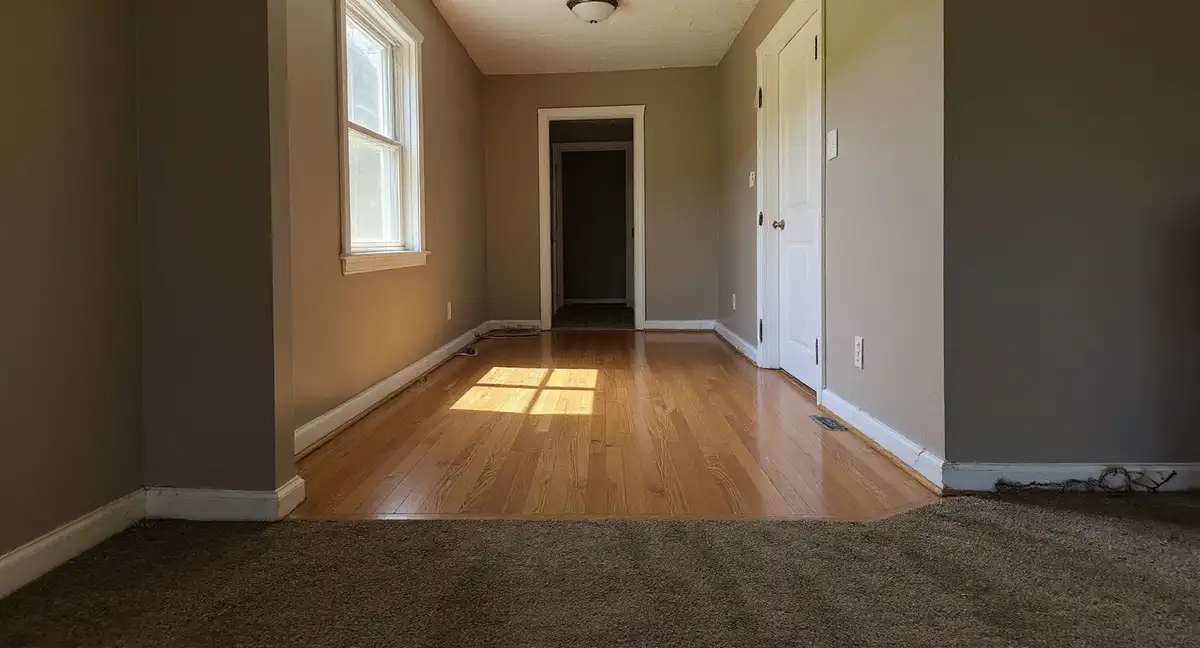
Look for these additional symptoms alongside sloping floors:
- Foundation cracks — stair-step or diagonal patterns in basement walls or exterior brick
- Gaps between walls and ceilings, widening on the high side of the slope
- Nail pops in drywall from shifted framing members
- Cracked interior drywall above door and window frames
- Chimney separation if the chimney sits on an independent footing
- Exterior brick cracks, especially stair-step patterns near corners
How Do You Evaluate Floor Slope and Decide Whether to Act?
Start by measuring and documenting the slope before contacting any professional. Your measurements establish a baseline and help you communicate the problem accurately. Use the 4-foot level method described above in every room on the affected floor. Record the slope direction and magnitude. Take photographs. Note how long you have noticed the slope and whether it seems to be getting worse.
Check the basement or crawl space directly beneath the sloping area for visible signs of foundation movement. Look for cracks in foundation walls, gaps between the sill plate and the top of the foundation wall, and any visible displacement of support columns or beams. Water stains, efflorescence (white mineral deposits), and active moisture in this area may indicate the drainage issues or plumbing leaks that are driving settlement. Document what you find.
If the slope exceeds 1/2 inch over 10 feet or is progressing, schedule an evaluation with a structural engineer. An independent structural engineer provides a diagnosis that is not tied to selling a particular repair. Their report identifies the cause of movement, quantifies the severity, and recommends appropriate repairs if needed. This report becomes your reference document for evaluating contractor proposals and understanding the scope of the problem. For information on evaluation and repair costs, see the cost and economics page.
Measure floor slope with a 4-foot level in every room on the affected floor. Slopes exceeding 1/2 inch over 10 feet warrant professional evaluation. Check the basement or crawl space for foundation cracks and water damage beneath the sloping area. If the slope is progressing, schedule a structural engineer evaluation rather than continuing to monitor.
Does Floor Slope Get Worse at Certain Times of Year?
Floor slope caused by foundation settlement follows the same seasonal pattern as the crack symptoms that usually accompany it. In Kansas City, differential settlement accelerates during the summer contraction phase (August-September) when Wymore-Ladoga clay dries and shrinks beneath footings. A floor that reads 1/2 inch of slope per 10 feet in April may read 5/8 inch per 10 feet by October. If you measure your floor slope quarterly, the September reading will typically show the most change from the prior measurement.
Floor slope attributable to floor joist issues — not foundation settlement — does not follow a seasonal cycle. If the floor slopes differently in summer than winter, that seasonal variation is a strong indicator of foundation movement rather than framing failure. Framing-related slope is consistent year-round. Foundation-related slope worsens predictably during contraction seasons and may partially recover when the soil re-saturates in spring — though it never returns fully to its original position because each cycle adds permanent settlement increment.
In Des Moines, floor slope changes most rapidly during spring (March-June) when hydrostatic uplift pressure pushes up against basement slabs. Upward slab pressure can temporarily raise certain sections while lateral wall pressure tilts others, creating apparent floor slope changes that settle back slightly after the peak season. Using a 4-foot digital level at the same measurement points in October and again in May captures both the contraction-driven change and the spring hydrostatic effect.
Which Repair Methods Address Sloping Floors from Foundation Settlement?
Sloping floors caused by foundation settlement are addressed at the footing level — stabilizing and lifting the settling section of the foundation. Push piers are the most direct approach for homes with full basements and masonry construction: steel tubes are driven to bedrock and the hydraulic system lifts the settled section back toward level. The degree of lift achievable depends on how long the settlement has progressed and whether secondary damage (cracked joists, broken plumbing) limits how far the structure can be safely moved.
For slab-on-grade homes where the concrete slab itself has settled rather than the perimeter foundation, interior slab piers installed through the slab floor provide lift from below. For settled areas of interior concrete flooring in basements — where the slab has sunk relative to the walls — polyurethane foam injection (polyjacking) can fill voids and lift the slab without the structural disruption of pier installation. Sloping floors from chimney separation or framing failures require different diagnoses and different repairs — pier installation addresses foundation settlement, not framing. See the cost page for current pricing by repair type.
How Does Floor Slope Present Differently in Kansas City and Des Moines Homes?
Sloping floors appear in both metros but from different root causes — which affects both how the slope progresses seasonally and which repair approach is appropriate.
In Kansas City, sloping floors are predominantly caused by differential settlement from clay contraction beneath footings. As Wymore-Ladoga clay dries during summer drought, voids form beneath footings and the foundation section above those voids drops incrementally. The slope runs toward the settling section. KC floor slope is most pronounced in September-October following the dry season, and may partially recover in spring when clay re-expands — though never fully recovering its original position. Ranch homes and Cape Cods from the 1940s-60s with shallow footings are the most likely KC candidates, especially where a prior downspout or drainage problem has localized the clay contraction beneath one section of the foundation.
In Des Moines, sloping floors can result from two distinct mechanisms depending on the home's location. Older core neighborhoods (Beaverdale, Sherman Hill, Drake) may show settlement-driven slope similar to KC's pattern. But in many Des Moines metro homes, floor slope near perimeter walls reflects hydrostatic uplift pressure on the basement slab — the glacial till's trapped water pushing upward against the slab from below. This uplift slope is different: it tends to raise the slab near the perimeter walls and create a subtle dome toward the center, rather than the directional tilt toward one corner that settlement produces. If your Des Moines floor slopes subtly upward toward the walls rather than downward toward a corner, hydrostatic uplift may be the mechanism.
How to Measure and Track Floor Slope Over Time
Floor slope monitoring requires consistent measurement points and a reliable measurement tool. The goal is detecting change between observations — not achieving precise engineering accuracy on the first attempt.
Use a 4-foot digital level or torpedo level for initial assessment. Place the level parallel to the suspected slope direction in several locations around the floor. Note the bubble position and whether the floor reads level, sloping toward one wall, or sloping toward one corner. Mark the positions on a floor plan sketch. For quantitative measurement, a digital level reads the slope angle directly; a traditional level can be combined with shims to measure deflection in inches.
Establish measurement lines across the floor. Run a taut string from wall to wall at floor height along two perpendicular axes. Use a ruler to measure the gap between the string and the floor surface at regular intervals (every 2 feet). This creates a cross-section profile of the floor. Map it to a sketch. Repeat along the same lines at each quarterly observation.
The marble test is a rough but useful supplement. Place a marble or golf ball on a hard floor in the affected area. The direction it rolls confirms which way the floor slopes. This doesn't give you quantitative data, but it quickly confirms whether slope is consistent across the room or varies — useful for ruling out localized joist issues.
Monitoring calendar: In Kansas City, take measurements in September (post-drought maximum settlement) and March (post-freeze, pre-expansion). In Des Moines, measure in late April (peak hydrostatic pressure) and September. Any increase in slope between observations confirms ongoing movement.
Sloping Floors: What You Can Assess Yourself vs. What Needs a Professional
Homeowners can measure floor slope accurately and establish a useful monitoring baseline — but distinguishing between the multiple causes of sloping floors (foundation settlement, joist failure, beam shrinkage, hydrostatic uplift) requires professional assessment.
What homeowners can reliably do
- Measure slope with the string-line or level method and establish dated baseline measurements
- Distinguish directional slope from localized bounce. Foundation settlement produces a consistent directional tilt toward one corner or wall. Joist or beam problems produce localized bounce (floor deflects under load) without consistent directional tilt. If your floor is bouncy but level, the problem is likely in the floor system, not the foundation.
- Check whether the slope is seasonal. If the floor slopes measurably worse in September than in April, foundation-related soil movement is the likely cause. If the slope is consistent year-round, framing issues are more probable.
- Correlate slope with other symptoms. Foundation settlement that causes floor slope also causes stair-step cracks in the basement below the sloping section and sticking doors on the floor above. If these correlate geographically, you have good evidence of foundation-driven slope.
When professional assessment is needed
Any floor slope over 1 inch per 10 feet on a 4-foot level, or any slope that has measurably increased between observations, warrants professional evaluation. The evaluation determines whether the cause is foundation settlement (requires piering), joist failure (requires floor system repair), or hydrostatic uplift (requires drainage and waterproofing). Treatment depends entirely on correct diagnosis.
Frequently Asked Questions About Sloping Floors
- Do foundation problems get worse over time?
- Foundation problems are progressive. The soil conditions driving settlement do not self-correct. A floor slope that measures 1/2 inch over 10 feet this year may reach 3/4 inch or more within several years as seasonal shrink-swell cycling continues to advance differential settlement. Moisture patterns, drainage changes, and tree root activity can accelerate the rate of progression. Early evaluation consistently results in less extensive and less expensive repairs than waiting until movement has compounded over multiple seasons.
- Can I sell my house with foundation problems?
- You can sell a home with foundation problems, but you are legally required to disclose known defects in most states, including Kansas and Missouri. Unrepaired foundation issues reduce buyer interest and sale price. Many sellers choose to complete repairs before listing because the repair cost is typically less than the price reduction buyers demand for unresolved structural concerns. A transferable repair warranty from the contractor can reassure buyers and preserve more of the home's value.
- Why do so many Kansas City homes have foundation problems?
- Kansas City sits on the Wymore-Ladoga soil complex, a clay formation containing 60-80% clay with a 'very high' shrink-swell rating from the USDA. This expansive clay swells when wet and contracts when dry, exerting tremendous force against foundations every seasonal cycle. Add that 30.72% of KC housing was built between the 1940s and 1960s — decades before modern foundation engineering standards — and you have a large inventory of aging foundations on some of the most aggressive soil in the Midwest.
- What is the best foundation repair method?
- There is no single best method — the right repair depends on the specific failure mode. Settlement from bearing capacity failure or soil compression requires piering (push piers or helical piers) to transfer the home's load to stable soil or bedrock. Bowing basement walls require wall anchors or carbon fiber reinforcement. Sinking concrete slabs require polyjacking. A qualified structural engineer diagnoses the failure mode first, then recommends the appropriate repair method for the specific conditions.
- Does homeowner's insurance cover foundation repair?
- Standard homeowner's insurance policies typically exclude foundation repair caused by settlement, soil movement, or poor drainage. Insurance covers sudden, accidental events — a burst pipe that erodes soil beneath a footing, for example. Gradual settlement from clay shrink-swell cycling is considered a maintenance issue and is excluded in most policies. Some homeowners have success with claims when plumbing leaks are the documented cause of soil erosion beneath the foundation. Review your policy's exclusions and consult your agent for specifics. For more on costs, visit the cost and economics page.