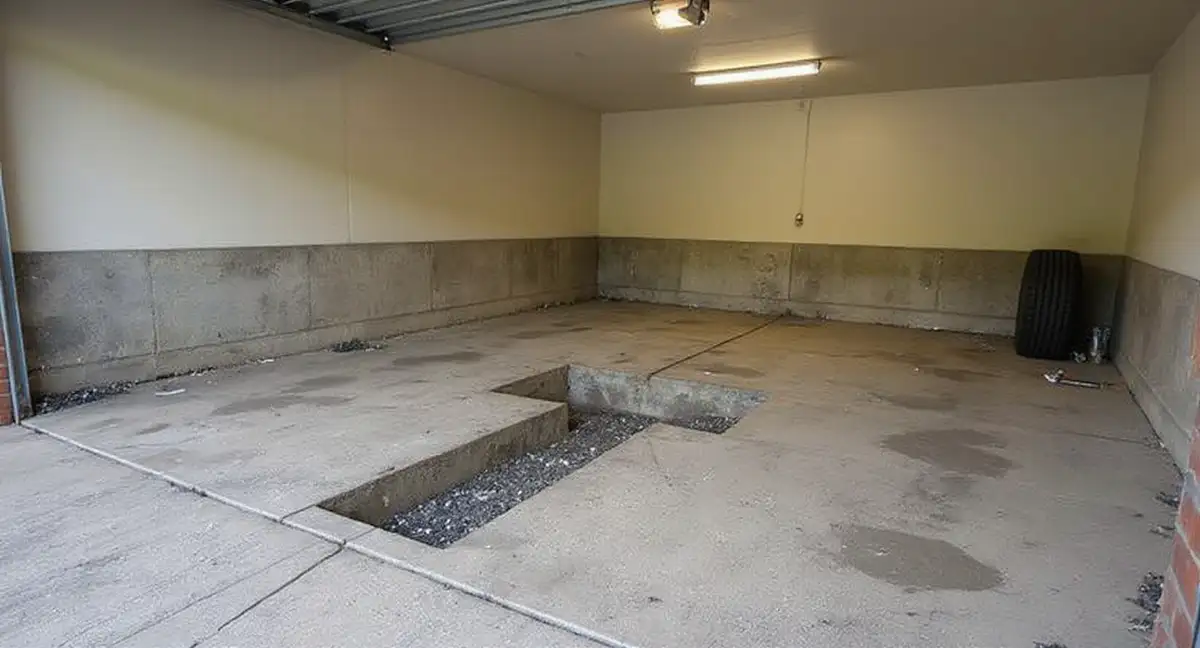
A sinking garage floor means the soil beneath the concrete slab has compressed, eroded, or washed away, leaving a void that allows the slab to settle under its own weight and the weight of anything parked on it. Garage slabs are poured directly on grade — they sit on the soil surface rather than on deep footings like the perimeter walls of your home. That makes them entirely dependent on the stability of the subgrade beneath them. When that subgrade changes, the slab follows it downward. The gaps you see between the slab edge and the garage walls, or the slope you feel when walking across the floor, are the visible evidence of slab settlement void formation below.
Garage floor sinking is one of the most common slab-on-grade failures in the Midwest, and it is almost always a soil problem rather than a concrete problem. The concrete itself may be perfectly sound — no cracks, no spalling, no deterioration. The slab is sinking because the ground beneath it is no longer where it was when the slab was poured. Understanding what type of soil movement is occurring beneath your garage floor determines whether polyjacking, slab replacement, or drainage correction is the appropriate response.
What Does a Sinking Garage Floor Look Like?
The most visible sign of garage floor sinking is a gap between the slab edge and the bottom of the garage wall — a space that was not there when the home was built. This concrete slab separation occurs because the slab drops away from the fixed wall while the wall (which sits on a footing) holds its position. The gap may be uniform around the perimeter or wider on one side than the other, depending on where the subgrade has lost the most support.
Garage threshold displacement is another early indicator that homeowners notice. The transition between the garage floor and the house entry door develops a lip or step that was not part of the original construction. The garage slab has dropped relative to the door threshold, creating a tripping hazard and a visible height difference. Water may pool at the threshold during rain because the slab now slopes toward the house wall instead of toward the garage door opening.
Apron joint gaps appear where the garage slab meets the driveway apron outside the garage door. The apron is a separate concrete pour that often settles at a different rate than the garage slab. A gap or height difference at this joint — sometimes wide enough to catch a shoe or a tire — indicates that one or both slabs have settled. The apron joint is also a common entry point for water that accelerates subgrade erosion beneath both slabs.
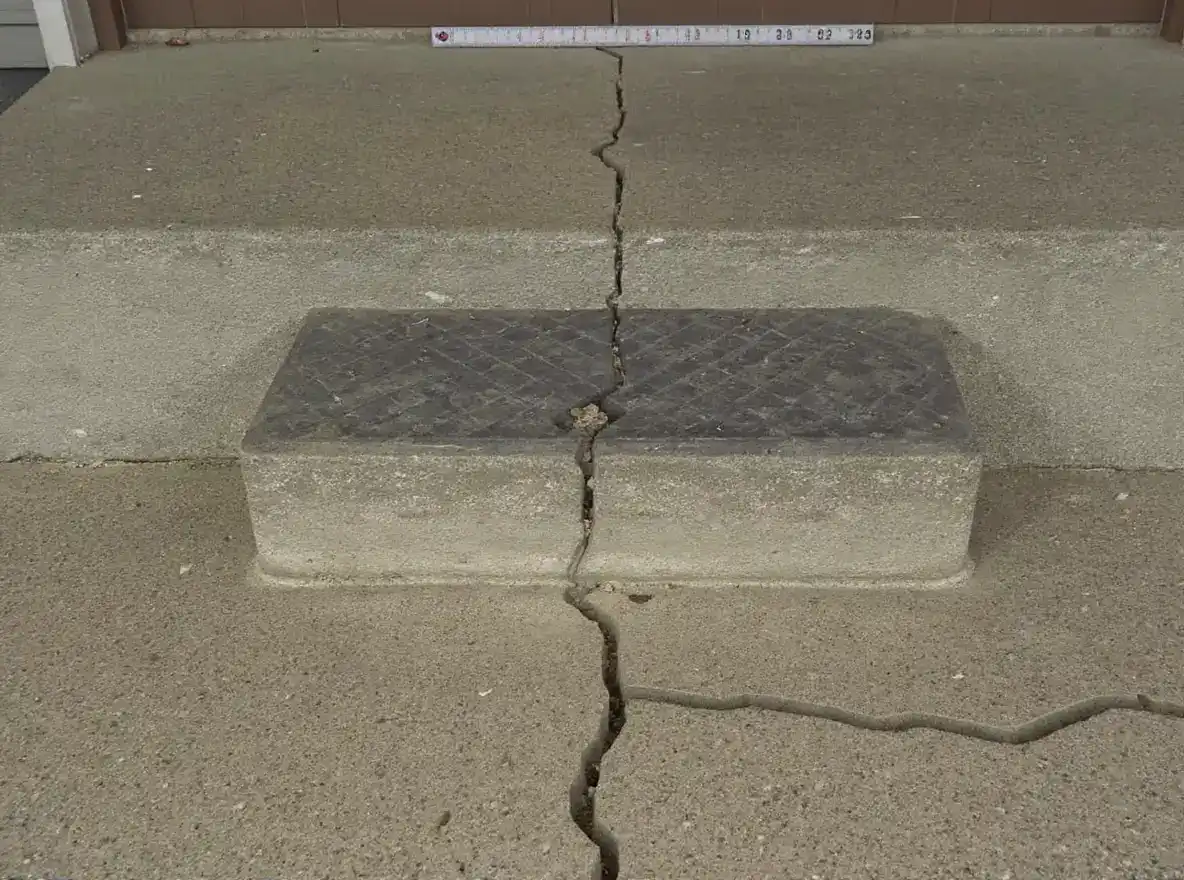
Control joint failure reveals the slab's settlement pattern. Control joints are the lines scored or cut into the garage slab surface to control where the concrete cracks during curing. When the subgrade settles unevenly, the slab sections on either side of a control joint drop to different elevations, creating a visible step or lip at what was once a flush joint. Running your hand across the joint and feeling a height difference between the two sides confirms differential slab settlement.
What Causes a Garage Floor to Sink?
Three soil mechanisms cause garage floor sinking: fill soil compaction, subgrade erosion from water flow, and moisture-driven soil volume change — and most sinking garage floors involve more than one. The relative contribution of each mechanism depends on the age of the home, the soil type, and the drainage conditions around the garage. Identifying which mechanism is primary determines the right repair approach.
Garage floor sinking is almost always a soil problem rather than a concrete problem. The concrete itself may be perfectly sound — the slab is sinking because the ground beneath it is no longer where it was when the slab was poured.Fill soil compaction is the most common cause of garage floor sinking in homes built on developed lots. During construction, the basement or foundation is excavated, the footings and walls are poured, and then fill soil is placed back against the walls and beneath the garage slab to bring the grade up to the slab elevation. If that fill is not mechanically compacted in controlled lifts — typically 6 to 8 inch layers, each compacted to 95% Proctor density — it will continue to compress under load for years after construction.
Des Moines metro suburbs developed since the 1990s — Ankeny, Waukee, and Grimes in particular — frequently show garage floor settlement where construction fill over native glacial till was inadequately compacted during rapid subdivision development. The pace of construction during housing booms often meant fill was placed in thick lifts without adequate compaction testing. The glacial till beneath is stable, but the 2 to 4 feet of fill between the till and the garage slab compresses gradually over the first 5 to 15 years after construction. For detailed information about how Midwest soil types behave beneath foundations, see the soil science page.
Subgrade erosion from water infiltration washes fine soil particles out from beneath the slab, creating voids. Water enters through the apron joint gap, through cracks in the slab, or from grading that directs surface water toward the garage. Once beneath the slab, water follows gravity along the subgrade surface, carrying fine silt and clay particles with it and depositing them at low points or drainage exits. Over months and years, this internal erosion creates voids — pockets of empty space beneath the slab that the concrete eventually bridges until the unsupported span exceeds the slab's structural capacity.
Soil volume change from the shrink-swell cycle contributes to sinking in clay-rich soils. When clay soil beneath the slab dries and shrinks, it pulls away from the underside of the concrete, creating a gap. The slab does not follow the soil downward because the slab is rigid. When the soil re-wets and expands, it may not fully recover its original volume — some of the gap remains. Each seasonal cycle ratchets the effective subgrade elevation downward, producing gradual cumulative slab settlement void formation.
Is a Sinking Garage Floor Cosmetic or Structural?
A sinking garage floor is structural in the sense that the subgrade has failed, but it is typically independent of your home's perimeter foundation — the garage slab and the house foundation are separate structural systems. The garage slab sits on grade. The perimeter walls sit on footings. The slab can settle significantly without affecting the structural integrity of the foundation walls, roof framing, or the rest of the house. This distinction matters because it means garage floor sinking is usually a slab problem, not a foundation problem.
The exception is when slab bearing failure coincides with perimeter wall settlement. If the garage wall footing is also settling — visible as stair-step cracks in the garage block wall or a leaning garage wall — the problem extends beyond the slab to the structural perimeter. In that case, the slab and the footing are both responding to the same subgrade failure, and the repair must address both systems.
Settlement magnitude determines the practical severity for homeowners. A 1/4-inch gap between the slab and the wall is early-stage settlement. A 1-inch gap with visible slab slope is moderate settlement that creates functional problems — water entry, difficulty closing the garage door, tripping hazards at thresholds. Settlement beyond 2 inches often means the slab has cracked as well, because the unsupported span exceeded the slab's bending capacity.
Garage door operation is often the functional trigger that motivates homeowners to address floor sinking. As the slab settles away from the garage door header, the door seal no longer meets the floor uniformly. The door may bind on one side, leave a visible gap under one corner, or fail to seal against wind-driven rain and snow. Automatic garage door openers may strain against the uneven travel, shortening the opener's service life and creating safety concerns with door balance.
What Other Problems Appear Alongside a Sinking Garage Floor?
Garage floor sinking often appears alongside other slab-on-grade settlement symptoms on the same property because the subgrade conditions affecting the garage are affecting other flatwork too. The same fill compaction deficiency or drainage problem beneath the garage slab is likely present beneath the driveway, sidewalks, and patio slabs poured at the same time during original construction.
Check for these related conditions when your garage floor is sinking:
- Driveway settlement or cracking, especially near the garage apron joint
- Sidewalk sections that have settled or tilted, creating trip hazards
- Patio slab settlement, particularly patios adjacent to the foundation wall
- Cracks in the garage foundation walls — stair-step patterns in block walls or vertical cracks in poured walls
- Basement floor slab settlement (same fill compaction issue beneath the basement slab)
- Water pooling against the foundation wall where garage slab grading has reversed
If the garage shares a wall with the house, check the interior rooms on the other side of that shared wall for signs of movement. Sticking doors, drywall cracks above door frames, and sloping floors in rooms adjacent to the garage may indicate that the settlement extends beyond the garage slab into the house foundation.
How Do You Evaluate a Sinking Garage Floor Before Calling Anyone?
Start by measuring the settlement and identifying the water sources that may be causing subgrade erosion — these two diagnostic steps determine whether you need immediate professional evaluation or whether drainage correction may slow the progression. Use a long straightedge or a four-foot level to map the slab's current profile. Lay the level on the floor in multiple directions and measure the gap beneath it at the low points. Record the gap between the slab edge and the wall at multiple locations around the perimeter.
Identify every point where water enters or flows toward the garage slab. Check the apron joint for gaps that allow surface water to flow beneath the slab. Check gutters and downspouts — are any discharging within 6 feet of the garage? Look at the exterior grading. The soil surface should slope away from the garage in all directions at a minimum of 1/4 inch per foot. Reverse grading — soil that slopes toward the garage — directs water under the slab and accelerates subgrade erosion.
Correcting drainage and grading will not reverse settlement that has already occurred, but it removes the ongoing cause of subgrade erosion. Extending downspouts, regrading the soil around the garage perimeter, and sealing the apron joint gap are homeowner-accessible improvements that reduce water infiltration beneath the slab. These steps are worth doing regardless of whether you pursue slab repair, because any repair will last longer when the water problem is addressed.
For slabs that have settled but remain intact, polyjacking is the standard repair approach. Polyjacking involves drilling small holes through the slab surface and injecting expanding polyurethane foam into the void beneath the concrete. The foam fills the void, expands to lift the slab back toward level, and cures into a stable, water-resistant material that does not compress or erode. The process typically takes a few hours for a standard two-car garage and the slab is usable within hours of completion.
For slabs that have cracked into multiple sections, spalled on the surface, or settled so severely that the concrete is broken, full slab replacement is more appropriate than polyjacking. Polyjacking works by lifting an intact slab as a unit. If the slab has broken into independent pieces, each piece lifts separately and the result is uneven. A contractor experienced in slab-on-grade work can evaluate whether polyjacking or replacement is the better option for your specific situation. For repair cost information, see the cost and economics page.
Measure the gap between the slab edge and wall at multiple points. Identify and correct water sources causing subgrade erosion — extend downspouts, fix grading, seal the apron joint. For intact slabs, polyjacking fills voids and lifts the slab back to level. For severely cracked slabs, full replacement is more appropriate. If garage walls also show cracking or leaning, get a structural engineer involved.
When Does Garage Floor Settlement Accelerate in Midwest Homes?
Garage floor slabs sitting on poorly compacted fill or eroded soil settle most rapidly during two conditions: after heavy rainfall events that wash loose material from beneath the slab, and during extended droughts that contract clay fill and open voids. In Kansas City, the spring rainfall season (April-May) and the late-summer drought (August-September) are the two peak progression periods. A gap between the garage floor and the house foundation that measured 1/4 inch in spring may measure 3/8 inch by October following a dry summer.
Frost heave adds a third seasonal variable for garage slabs specifically. Unlike basement floors below the frost line, garage slabs in Kansas City (36-inch frost depth) and Des Moines (42-inch frost depth) are sometimes at or near the depth where seasonal freezing can create upward pressure. If the garage slab has both a gap at the house connection and periodic upward ridging near the door threshold in winter, frost heave is likely acting on the shallow slab. This is a different problem from settlement and is addressed differently.
The most diagnostic seasonal observation for a sinking garage floor is the gap at the house connection measured in October versus March. If the October reading (post-drought contraction) shows a larger gap than the March reading (post-thaw), the underlying soil is actively compressing or eroding — not simply cycling. A gap that grows net 1/8 inch per year indicates a trend that polyjacking will address today but will recur if the soil erosion pathway is not corrected.
Which Repair Methods Address a Sinking Garage Floor?
The right repair for a sinking garage slab depends on whether the problem is soil void formation (erosion or compaction) or ongoing bearing capacity failure beneath the slab. For smaller settled areas where the slab itself is still structurally sound and the settlement is from voids forming under compressible fill, polyurethane foam injection (polyjacking) is the standard approach: small holes drilled through the slab allow expanding foam to fill voids and lift the concrete back toward level. The foam sets in minutes, the holes are patched, and the area can be driven on the same day.
For more significant garage slab settlement — particularly where the slab has separated substantially from the house foundation or where the soil beneath has experienced major erosion — interior slab piers provide permanent bearing support. Unlike polyjacking, which fills existing voids, slab piers drive down to stable strata and support the slab from below independently of whatever soil condition exists. Polyjacking addresses the current void; slab piers address the future bearing problem. The polyjacking vs. mudjacking comparison explains the material differences between the two foam-lifting options. For current cost ranges for both approaches, see the cost and economics page.
Does Garage Floor Sinking Present Differently in Kansas City vs Des Moines?
Garage floor sinking occurs in both metros but through different primary mechanisms — and the root cause affects both how the problem progresses and which repair approach applies.
In Kansas City, garage floor sinking is primarily caused by clay soil contraction creating voids beneath the slab. During summer drought, Wymore-Ladoga clay contracts and can pull away from the underside of the garage slab, leaving the concrete unsupported over an air void. When the clay re-expands in spring, it doesn't fully return to its original position — each cycle adds permanent settlement increment. The result: the garage slab sinks in sections that track the worst clay contraction areas, often near the exterior walls where clay dries fastest. KC garage floor settlement is typically worse in fall (after peak contraction) and partially stable in spring.
In Des Moines, garage floor sinking more often reflects frost heave combined with glacial till hydrostatic pressure. Iowa's 42-inch frost depth means garage slabs — which are at or near the frost boundary — experience upward ice pressure from below during winter. Repeated freeze-thaw cycling can displace the slab unevenly: frost heave pushes sections up, then the slab drops as ice melts, sometimes settling below its original elevation. Des Moines garage floor problems often show ridge-and-valley patterns from differential frost heave rather than KC's single-direction sinking pattern.
How to Track a Sinking Garage Floor
Garage floor monitoring focuses on two measurements: the gap at the house connection and the slope across the slab surface.
Measure the gap where the garage slab meets the house foundation. Use a ruler or calipers. Measure at the left corner, center, and right corner of the garage-house connection. Record all three measurements with dates. A gap that is larger at one corner than the other confirms differential settlement rather than uniform sinking.
Measure slab slope with a 4-foot level. Check slope in several directions — parallel to the house connection, perpendicular to it, and diagonally. Record which direction the floor slopes and by approximately how much (bubble deviation or digital level reading). A consistently sloping floor points toward uniform settlement; a floor with ridges and valleys (level in one spot, sloping in another) indicates differential movement or frost heave.
Photograph the gap at consistent reference points. Place a ruler against the garage wall adjacent to the gap and photograph the full gap width at each corner. A consistent reference point makes gap progression visible in side-by-side comparison.
Monitoring calendar for Kansas City: Measure in September (post-drought, maximum gap from clay contraction) and March (post-freeze, pre-expansion). Any increase in gap width October-to-October year over year confirms progressive settlement. In Des Moines: measure in May (post-frost, peak heave damage visible) and October (pre-freeze baseline).
What Can You Do About a Sinking Garage Floor — and What Requires a Pro?
Garage floor sinking is one of the more accessible foundation problems for homeowners to address — with the important caveat that repair method selection depends on correctly diagnosing the cause.
What homeowners can do
- Correct drainage at the garage perimeter. Water pooling near the garage foundation or flowing toward it accelerates the clay contraction or frost heave driving the sinking. Extend downspouts away from the garage, regrade soil to slope away, ensure the driveway slopes toward the street rather than toward the garage.
- Seal the gap at the house-garage connection. A growing gap at the house connection is a water intrusion pathway. Flexible polyurethane caulk (not rigid epoxy) in this gap prevents water from flowing beneath the slab, which contributes to further erosion. This is a maintenance action, not a structural repair.
- Install a threshold or ramp over minor height differences. A settled section that's 1/2 inch below an adjacent section creates a tripping hazard. A beveled rubber threshold fills the height difference as a safety measure while you monitor whether the gap is stable or growing.
When professional repair is needed
- Gap at the house-garage connection greater than 3/4 inch — slab has dropped enough that polyjacking is likely more cost-effective than waiting
- Visible void beneath the slab edge (run your hand along the gap — can you feel air, or does soil meet the slab bottom?)
- Multiple sections of the slab at different elevations (differential settlement more complex than a simple void fill)
- Cracks in the garage slab surface with displacement across the crack face
Professional repair for garage floor sinking is typically polyjacking — foam injection that fills the void and lifts the slab in hours. It does not require concrete removal or replacement when the slab is structurally sound.
Frequently Asked Questions About Sinking Garage Floors
- Do foundation problems get worse over time?
- Garage floor sinking is progressive. The soil conditions causing slab settlement — void formation from subgrade erosion, fill soil compaction, and moisture-driven soil shrinkage — continue acting on the slab every season. A slab that has settled 1/2 inch this year will likely settle further next year unless the underlying void is filled and the cause of soil loss is addressed. Early intervention with polyjacking is consistently less disruptive and less expensive than full slab replacement.
- What type of soil causes foundation problems in Des Moines?
- Des Moines sits on glacial till deposited during the Wisconsin glaciation — a dense mixture of clay, silt, sand, and gravel compressed by ice sheets. The clay component (Nicollet-Webster soil complex) has moderate shrink-swell potential. More significantly for garage floors, the glacial till is often overlaid with construction fill that was placed during development. When that fill was not compacted to engineering specifications, it compresses under the weight of the concrete slab over subsequent years.
- What foundation problems are most common in Ankeny and West Des Moines?
- Ankeny and West Des Moines experienced rapid residential development from the 1990s through the 2010s. The most common foundation problem in these suburbs is slab settlement — garage floors, basement floors, and driveways sinking where construction fill was placed over native glacial till without adequate compaction. Garage floors are the most affected because garage slabs are poured on grade over fill, while the perimeter foundation walls rest on footings bearing on native soil below the fill layer.
- What is the best foundation repair method?
- The right repair depends on the failure mode. For sinking garage floors with intact concrete, polyjacking (injecting expanding polyurethane foam beneath the slab) fills the void and lifts the slab back to level. For slabs that are severely cracked, spalled, or broken into multiple sections, replacement is more appropriate. For garage floors that are sinking because the perimeter foundation wall is settling, piering addresses the wall while polyjacking addresses the slab independently.
- Can I finance foundation repair?
- Most foundation repair contractors offer financing options, and many polyjacking projects qualify for home improvement loans or lines of credit. Some homeowners use home equity lines, personal loans, or contractor-provided payment plans. For detailed information about repair cost ranges and financing approaches, see the cost and economics page at /cost/.