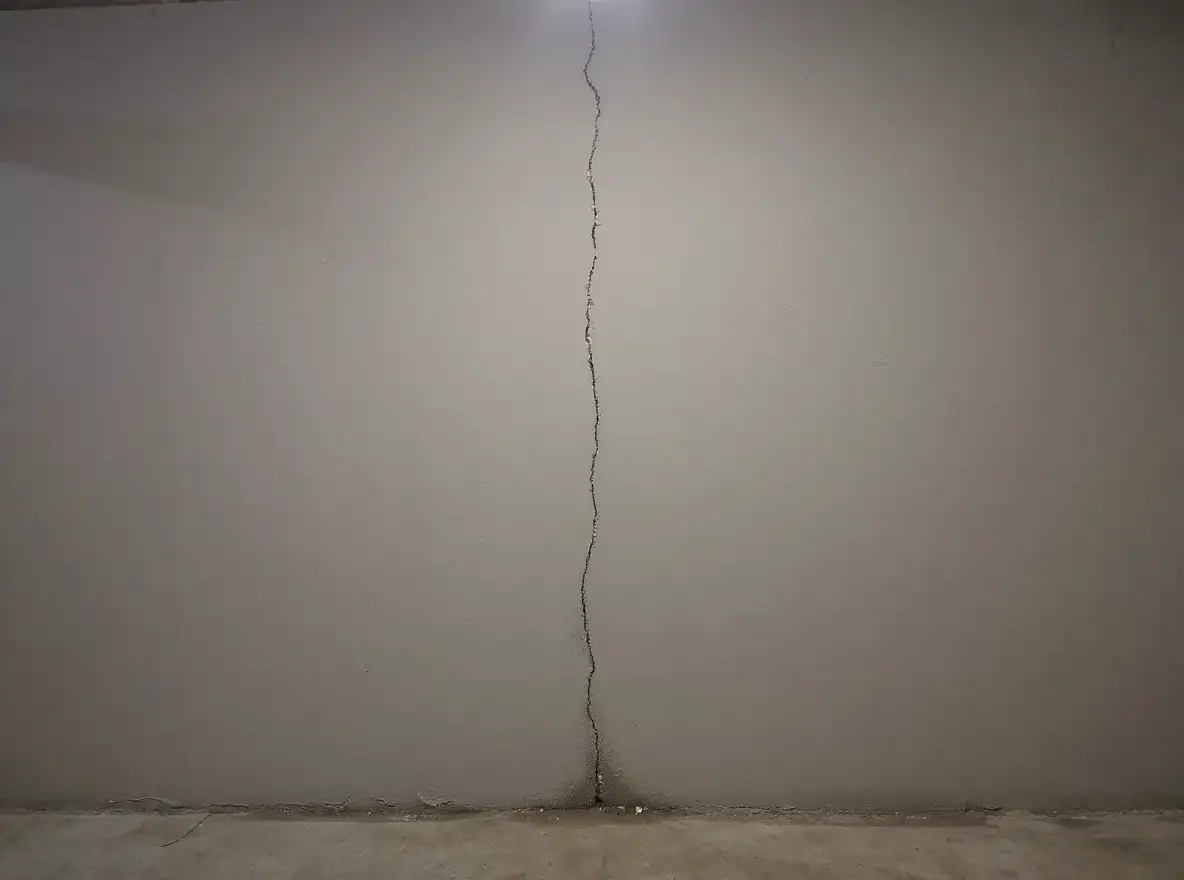
Vertical cracks in poured concrete walls are the single most common foundation crack type in Midwest homes, and most of them are not structural emergencies. The majority of vertical cracks form during concrete curing shrinkage — a normal chemical process that occurs in the first weeks after a wall is poured. Concrete loses moisture as it cures, and the resulting volume reduction creates tensile stress that the material cannot resist. The crack that forms is the concrete's way of relieving that stress. In a typical poured concrete basement wall, one to three vertical shrinkage cracks are expected.
The critical distinction is between a crack that formed once and stopped, and a crack that is actively changing. A stable shrinkage crack from the original pour is a maintenance item — seal it to prevent water infiltration and move on. A vertical crack that is widening, tapering from top to bottom, or showing lateral offset across the crack face indicates live structural movement that requires investigation. This page covers how to tell the difference.
What Does a Vertical Foundation Crack Look Like?
A vertical foundation crack runs roughly straight up and down along the wall, perpendicular to the floor and the top of the wall. In poured concrete, these cracks typically extend from somewhere near the top of the wall downward toward the floor or footing. They may run the full height of the wall or stop partway. The edges of the crack are usually clean and sharp in poured concrete, unlike the ragged, stepped pattern of mortar joint cracks in block walls.
Shrinkage cracks tend to appear at predictable locations in poured walls. They often form near the midpoint of long wall spans, where tensile stress is highest. They also appear at re-entrant corners — the inside corners of step-downs, window openings, and pipe penetrations — where the wall cross-section changes and stress concentrates. A vertical crack directly through the center of a window well opening is almost always a shrinkage crack following the stress riser created by the opening.
The critical distinction is between a crack that formed once and stopped, and a crack that is actively changing. A stable shrinkage crack is a maintenance item. A widening or tapering crack indicates live structural movement that requires investigation.The width profile of a vertical crack is its most diagnostic feature. A shrinkage crack is typically uniform in width from top to bottom — the same hairline dimension along its entire length. A settlement crack tapers: wider at the top and narrower at the bottom (or occasionally the reverse). The crack taper direction tells you which part of the wall is moving and in which direction, making it the first thing to assess after you identify the crack.
Look also for pour joint separation, which can mimic vertical cracks. Poured concrete walls are placed in sections, and the cold joint where one pour meets the next creates a built-in weak plane. Pour joints are straight, full-height, and evenly spaced along the wall. If a vertical line appears at a consistent spacing pattern, it may be a pour joint that has opened rather than a true crack.
Why Do Vertical Cracks Form in Poured Concrete?
Concrete curing shrinkage is the primary cause of vertical cracks in poured walls, and it is a normal material behavior rather than a defect. Portland cement concrete loses approximately 5% to 8% of its water volume during initial hydration and curing. The resulting volume reduction creates internal tensile stress. Concrete has high compressive strength but low tensile strength — roughly one-tenth of its compression capacity — so it cracks under tension rather than compressing under it. Vertical cracks are the relief mechanism for this tensile failure.
Thermal contraction is a secondary cause of vertical cracking in poured concrete walls. Concrete expands and contracts with temperature changes, and a basement wall experiences different temperatures at the soil-contact face versus the interior face. The resulting differential thermal strain creates tensile stress similar to shrinkage stress. In regions with large seasonal temperature swings — KC regularly spans from single digits in January to triple digits in July — thermal cycling opens and closes cracks throughout the year.
Settlement-driven vertical cracks have a different mechanism than shrinkage or thermal cracks. When the soil beneath one section of a footing compresses more than the adjacent section, the wall above bends. The tension side of that bend — typically the interior face of the wall — develops a vertical crack that tapers in the direction of the bending. The underlying soil behavior driving this settlement in Kansas City and Des Moines is the shrink-swell cycle in expansive clay, which is covered in depth on the soil science page.
KC homes built from the 1970s through 1999 — 28.45% of the metro housing stock — predominantly used poured concrete wall construction, making them the generation most prone to vertical curing cracks. Earlier decades favored concrete block, which develops stair-step cracks along mortar joints instead. The shift to poured concrete brought better structural performance overall but introduced curing shrinkage as a nearly universal cosmetic issue that homeowners routinely mistake for structural damage.
Is a Vertical Crack Cosmetic or Structural?
Most vertical cracks in poured concrete are cosmetic — the result of concrete curing shrinkage — but several characteristics separate cosmetic cracks from structural ones. A cosmetic shrinkage crack is hairline width (under 1/16 inch), uniform in width from top to bottom, shows no lateral displacement across the crack face, and has not changed since the home was built. A structural vertical crack tapers in width along its length, may show offset where one side is higher or further forward than the other, and may be actively widening over time.
Width alone does not determine structural significance — the change in width along the crack length matters more. A 1/16-inch crack that is the same width at the top and bottom is likely cosmetic shrinkage. A 1/16-inch crack at the top that narrows to a hairline at the bottom indicates the upper portion of the wall is rotating outward, which is a structural concern even at that modest width. Run a pencil point along both sides of the crack and observe whether the gap widens or narrows.
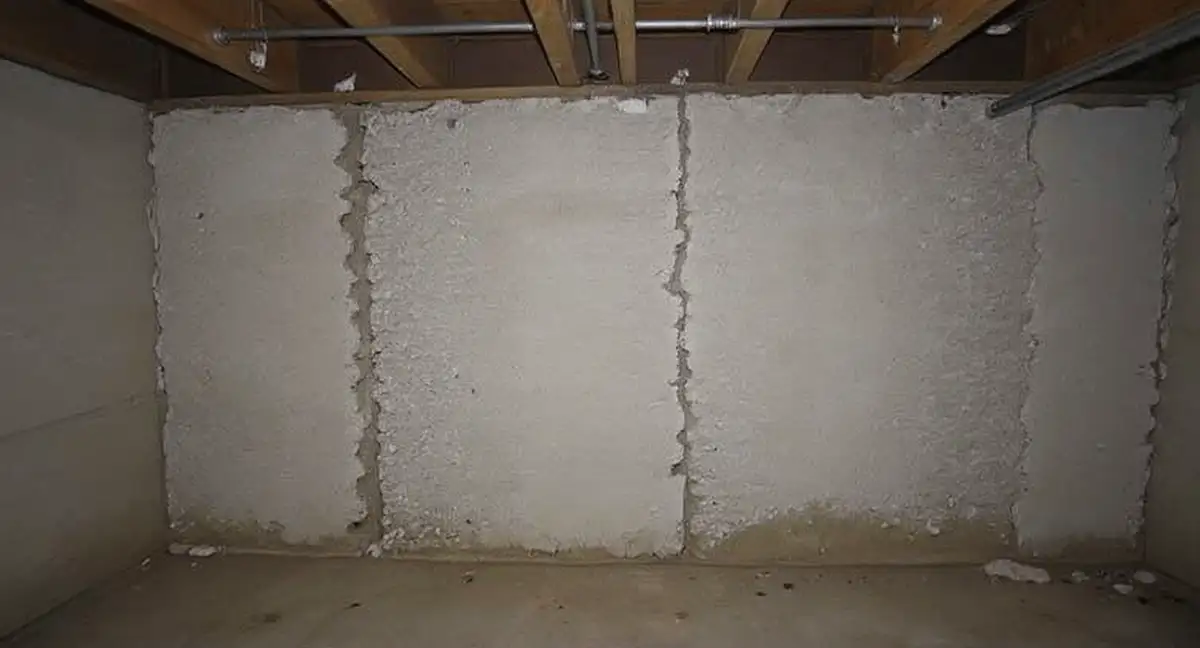
Lateral displacement across the crack is the strongest indicator of structural movement in a vertical crack. Place your fingertip across the crack and feel whether both sides are flush. If one side protrudes past the other — even by 1/32 inch — the wall sections have shifted relative to each other. Displacement indicates the wall is not simply separating in tension but is being acted on by forces that push or pull one side differently than the other.
Water infiltration through a vertical crack is a maintenance concern regardless of structural significance. Even a cosmetic shrinkage crack can transmit water during heavy rain or snowmelt, particularly in areas with high hydrostatic pressure. Sealing the crack with flexible urethane caulk or having it professionally injected with polyurethane or epoxy addresses the water problem without implying a structural repair is needed.
What Other Symptoms Appear With Vertical Foundation Cracks?
Cosmetic vertical cracks from curing shrinkage typically exist in isolation — no companion symptoms in the rest of the house. If your vertical crack is hairline, uniform in width, and you see no other signs of movement in the home, the crack is almost certainly a normal shrinkage artifact. The absence of related symptoms is itself a diagnostic indicator pointing toward cosmetic rather than structural origin.
Structural vertical cracks, by contrast, are usually accompanied by other signs of foundation movement throughout the home. If the same settlement that produced a tapering vertical crack is significant enough to bend the wall, it is significant enough to affect the floor framing above. Look for these companion symptoms:
- Doors or windows that stick or will not latch, especially on the floor directly above the cracked wall section
- Floors that slope toward the settling side of the foundation
- Drywall cracks above door and window frames on upper floors — these are the framing equivalent of foundation cracks, caused by the same differential movement
- Gaps appearing between walls and ceiling trim, or between the floor and baseboard, on one side of the home
- Diagonal cracks radiating from window or door corners in the foundation wall
The presence of multiple symptom types confirms that the foundation is experiencing active differential settlement rather than isolated concrete shrinkage. A single vertical crack with no other symptoms points to curing shrinkage. A vertical crack plus sticking doors plus a sloping floor on the same side of the house points to settlement that requires professional evaluation.
When Does a Vertical Foundation Crack Cross from Monitoring to Action?
Start with a careful visual assessment using the criteria outlined above: measure the width, check for taper, feel for displacement, and survey the rest of the home for companion symptoms. Write down what you find. Photograph the crack with a ruler or coin held next to it for scale. Date your observations. This baseline documentation becomes valuable whether you end up monitoring the crack yourself or showing it to a professional later.
For hairline cracks with no taper, no displacement, and no companion symptoms, the appropriate response is to seal the crack and monitor it. Hydraulic cement or polyurethane caulk applied from the interior provides a temporary water seal. Professional crack injection with expanding polyurethane fills the crack through the full wall thickness and provides a more durable seal. Neither treatment is a structural repair — they are moisture management measures for a cosmetic crack.
For cracks that taper, show displacement, or are accompanied by other symptoms, document everything and schedule a professional evaluation. A structural engineer can assess whether the movement is active or arrested, identify the soil condition driving the movement, and recommend whether monitoring, repair, or both are appropriate. An independent engineer's report is worth obtaining before soliciting contractor proposals because it establishes the scope of any needed work before anyone with a financial interest in selling a repair is involved.
Quarterly monitoring through a full seasonal cycle — March, June, September, and December — captures the full range of soil-driven movement in Kansas City and Des Moines. Mark crack endpoints with dated pencil lines perpendicular to the crack. Photograph the same section of the crack at each interval with a ruler for scale. If the crack remains stable through all four seasons, the movement that created it has likely reached equilibrium. If it grows during any season, the movement is ongoing and professional evaluation is warranted.
Most vertical cracks in poured concrete are cosmetic curing shrinkage. Check for taper (wider at one end), lateral displacement, and companion symptoms elsewhere in the home. If any of these are present, schedule a professional evaluation. If the crack is hairline and uniform, seal it for water protection and monitor quarterly.
For information on repair costs and financing options, see the cost and economics page. The right repair method depends on the type of movement — settlement versus lateral pressure versus heave — and a proper diagnosis must come before repair selection.
When Should You Monitor Vertical Foundation Cracks Most Closely?
Vertical cracks behave differently by crack type, and the seasonal monitoring window depends on which type you have. Concrete curing shrinkage cracks — the hairline vertical cracks that appear in poured walls within the first few years after construction — are essentially stable year-round. They formed as the concrete dried and will not grow significantly with seasons. These require periodic monitoring but rarely urgent action.
Vertical cracks caused by settlement are a different situation. In Kansas City, these follow the shrink-swell calendar: they typically widen most during August and September when clay contraction pulls support from footings, then partially close during spring saturation when the clay re-expands. A tapered vertical crack that measures 1/8 inch wide at the top in June may measure 3/16 inch wide at the top by September. The best monitoring window for settlement-related vertical cracks is late September in Kansas City — peak contraction — when any active movement will be at its maximum.
In Des Moines, the peak movement window for vertical cracks is spring (March-May), when snowmelt and rainfall together raise the water table and apply maximum hydrostatic uplift to basement slabs. Vertical slab cracks near the wall-floor connection may widen measurably as the combination of upward slab pressure and lateral wall pressure acts simultaneously. Monitoring Des Moines vertical cracks in late April captures this peak accurately.
Which Repair Methods Are Used for Vertical Foundation Cracks?
The repair method for a vertical crack depends entirely on whether the crack is cosmetic (curing shrinkage) or structural (settlement-driven). Hairline vertical cracks from concrete curing are sealed with polyurethane crack injection — a flexible, waterproof sealant that fills the crack and prevents water intrusion without adding structural strength. This is an appropriate repair for cracks that are confirmed stable and not growing.
Vertical cracks accompanied by settlement symptoms — sloping floors, sticking doors, growing width — require addressing the soil movement causing the crack, not the crack itself. Push piers stabilize and lift settling footings for homes with sufficient structural weight. Once settlement is stopped, the crack can be sealed. Attempting to seal a crack from a settling foundation without addressing the settlement is ineffective — the seal will fail as the foundation continues to move. For current pricing on crack injection and piering in the Kansas City and Des Moines markets, see the cost and economics page.
Do Vertical Foundation Cracks Appear Differently in Kansas City and Des Moines?
Vertical cracks are common in both metros, but the relative proportion of cosmetic vs. structural vertical cracks differs due to different soil behavior.
In Kansas City, vertical cracks in poured concrete walls are very common and frequently cosmetic. KC's climate drives significant seasonal temperature swings, and concrete poured in hot weather contracts more as it cures. The 60-80 percent clay soil also contributes: as clay expands and contracts against poured walls, it creates differential pressure across the wall surface that can propagate existing shrinkage cracks or create new ones. The most useful diagnostic in KC is whether the vertical crack changes width seasonally (widest in late summer when clay contracts, narrowest in spring) — this seasonal variation confirms soil-related movement rather than static curing shrinkage.
In Des Moines, vertical cracks in poured concrete are typically associated with two specific conditions: wall corners and slab-floor connections. Glacial till's lateral pressure creates horizontal force that can produce vertical cracking at wall corners where the wall intersects perpendicular walls, creating a stress concentration point. Vertical cracks at the wall-floor slab connection (where the wall meets the basement floor) indicate frost heave or hydrostatic uplift pressure on the slab — a Des Moines-specific concern due to the 42-inch frost depth and high water table. In Des Moines, vertical cracks at wall-slab connections should be evaluated as potential hydrostatic uplift indicators, not just cosmetic shrinkage.
How to Determine If a Vertical Foundation Crack Is Growing or Stable
The most important question for vertical cracks is not the current width but the change rate. A stable 1/4-inch crack that has not moved in five years is a different situation than a 1/8-inch crack that appeared three months ago and has already grown.
Mark crack endpoints at both the top and bottom with dated pencil lines. Measure width at the widest point, the midpoint, and near both ends using a crack width gauge or feeler gauges. Record measurements with dates.
Check for tapering — does the crack change width along its length? A vertical crack that is wider at the top and narrows toward the bottom indicates the upper portion of the wall is being pulled outward — often from floor framing connections when the opposite end of the foundation settles. Tapered cracks reveal movement direction. A uniform-width vertical crack is more consistent with static curing shrinkage.
Check for lateral displacement. Run your finger perpendicular across the crack. Any step between the two crack faces — one side higher or farther forward than the other — confirms structural wall movement beyond simple tension cracking.
Monitoring timeline for Kansas City vertical cracks: Set measurements in March and September to capture the full annual moisture cycle. If readings are identical at both observations over two consecutive years, the crack has likely reached equilibrium. Any growth between observations restarts the monitoring clock.
Monitoring timeline for Des Moines vertical cracks: Set measurements in late April (spring peak) and late October (dry season baseline). Des Moines vertical cracks that widen April-to-April year over year indicate progressive hydrostatic loading on the wall.
When Can You Seal a Vertical Foundation Crack Yourself — and When Is It Not Enough?
Vertical cracks are the crack type most likely to be appropriate for homeowner-applied sealing — but only under specific conditions.
DIY sealing is appropriate when ALL of these are true
- The crack has been stable through at least two full annual cycles (no measurable growth between observations)
- The crack shows no lateral displacement across the face
- No companion symptoms are present (no sticking doors, no floor slope, no other cracks)
- The crack is in poured concrete (not block or stone)
- Width is under 1/4 inch
For cracks meeting all five criteria, a DIY polyurethane crack injection kit (available at hardware stores for $20-$40) can seal moisture and radon entry pathways. These surface-applied kits are not structural repairs — they prevent water infiltration. Follow the product instructions for surface preparation (dry, clean, free of dust and efflorescence).
DIY sealing is NOT appropriate when
- The crack has grown between any two observations
- You detect any displacement across the crack face
- The crack is tapered (wider at top or bottom)
- The crack is in a block or stone wall (different sealing approach needed)
- Other symptoms are present anywhere in the home
In these cases, sealing the crack does not address the underlying movement and creates a false sense of resolution. The movement that caused the crack continues, the seal fails within months, and you've lost the visual marker that was documenting progression. Get professional assessment before any sealing on actively moving cracks.
Frequently Asked Questions About Vertical Foundation Cracks
- How do I know if a crack in my foundation is serious?
- Crack width is the primary severity indicator. Hairline cracks under 1/16 inch are typically cosmetic, especially if they are vertical and uniform in width. Cracks between 1/16 and 1/4 inch warrant quarterly monitoring through a full seasonal cycle. Cracks wider than 1/4 inch, cracks that taper significantly from top to bottom, or cracks showing lateral displacement across the crack face indicate active structural movement and require professional evaluation.
- What is the shrink-swell cycle and how does it damage foundations?
- The shrink-swell cycle occurs when clay soil absorbs water and expands, then dries out and contracts. During the expansion phase, the soil exerts lateral pressure against foundation walls. During the contraction phase, it pulls support away from footings. In Kansas City, seasonal rainfall swings from 5.7 inches in May to 1.5 inches in January, driving this cycle repeatedly. Over years, the cumulative effect can convert a stable vertical shrinkage crack into a widening settlement crack as the soil beneath the footing compresses unevenly.
- Are older Kansas City homes more at risk for foundation problems?
- Homes built in the 1970s through the 1990s — which represent 28.45% of the Kansas City housing stock — predominantly used poured concrete walls and are the most likely to show vertical curing cracks. Older homes from the 1940s through 1960s used concrete block construction, which tends to develop stair-step cracks along mortar joints instead. Both age groups are vulnerable, but the failure patterns differ based on the construction method.
- Does homeowner's insurance cover foundation repair?
- Standard homeowner's insurance policies exclude foundation settlement, soil movement, and normal wear. Insurance typically covers foundation damage only when it results from a sudden, covered peril — a burst pipe flooding the soil beneath the footing, for example, or vehicle impact. Gradual settlement from seasonal soil movement, which is the cause of most foundation problems in the Midwest, is explicitly excluded from coverage. For more detail on costs and financing, see the cost and economics page.