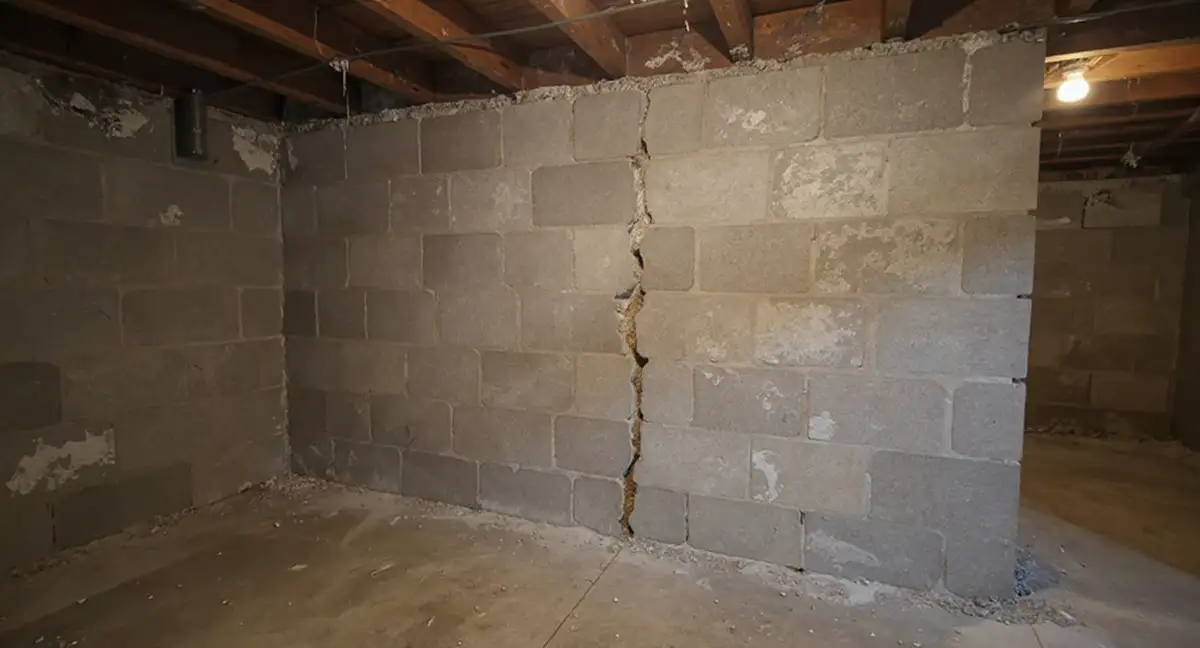
Every foundation crack tells a story about what is happening beneath your home — the direction, width, and location of the crack reveal the type of structural movement causing it. Foundation cracks are the most visible symptom of soil-driven structural movement, and they are the reason most Midwest homeowners first realize something may be wrong. Not all cracks are emergencies. Some are cosmetic byproducts of normal concrete curing. Others indicate active, progressive settlement that will worsen with every seasonal cycle. The difference between a crack that needs monitoring and a crack that needs immediate professional evaluation comes down to four factors: direction, width, displacement, and progression rate.
This page is a crack identification guide — it covers all four major crack types and helps you determine which one matches what you are seeing. Each crack type has its own detailed page covering causes, severity assessment, monitoring methods, and repair approaches. If you already know your crack type, go directly to the specific page. If you are unsure, read through the descriptions below to identify the pattern.
What Are the Four Types of Foundation Cracks?
Foundation cracks fall into four directional categories, and each direction corresponds to a different structural force acting on your foundation. Stair-step cracks follow mortar joints and indicate differential settlement. Horizontal cracks run straight across a wall and signal lateral soil pressure. Vertical cracks travel top-to-bottom and may be normal shrinkage or minor settlement. Diagonal cracks run at roughly 45 degrees from stress concentration points like window and door corners, indicating one section of the foundation is moving while an adjacent section remains stationary.
Stair-Step Cracks
Stair-step cracks follow the mortar joints in block or brick walls in a stepping pattern, typically at a 30 to 60-degree angle. They are the signature crack pattern of differential settlement — one part of the foundation sinking while another part holds its position. In Kansas City, where 30.72% of the housing stock was built between the 1940s and 1960s using concrete block foundations, stair-step cracks are the most common structural crack type. The mortar joints fail before the blocks because mortar has lower tensile strength than the block units themselves. Read the full stair-step crack guide.
Horizontal Cracks
Horizontal cracks are the most structurally significant crack type in basement walls. They run straight across the wall, typically at the mid-height point or just below grade level, and indicate that lateral earth pressure from soil outside the wall is exceeding the wall's structural capacity. In Des Moines, where clay-rich glacial till creates persistent hydrostatic pressure against basement walls, horizontal cracks are more prevalent than in markets dominated by shrink-swell settlement. Any horizontal crack in a basement wall requires professional evaluation regardless of width. Read the full horizontal crack guide.
Vertical Cracks
Vertical cracks in poured concrete walls are the most common foundation crack — and the most commonly misunderstood. Many vertical cracks result from concrete curing shrinkage, a normal process that occurs as poured concrete loses moisture during its initial set. These shrinkage cracks are typically hairline width, uniform from top to bottom, and do not indicate structural movement. However, vertical cracks can also indicate settlement or frost heave if they are wider at the top than the bottom (or vice versa), show lateral displacement across the crack face, or are actively widening. Read the full vertical crack guide.
Diagonal Cracks
Diagonal cracks radiate from stress concentration points — typically the corners of windows, doors, and other openings — at approximately 45 degrees. They indicate differential settlement: one section of the foundation is moving while the adjacent section is not. The crack propagation pattern follows the path of least resistance through the wall material, which in concrete and masonry tends toward a 45-degree angle from the point of maximum stress. Diagonal cracks are particularly common in homes on Kansas City's expansive Wymore-Ladoga clay, where seasonal moisture variation drives uneven settlement across the foundation footprint. Read the full diagonal crack guide.
How Do You Measure Foundation Crack Severity?
Crack width is the single most important severity measurement, but it is not the only one — displacement, location, and change over time all factor into the assessment. A 1/4-inch crack that has been stable for five years is a different situation than a 1/8-inch crack that appeared three months ago and is visibly growing. Foundation crack mapping — documenting the location, width, direction, and progression of every crack — creates a diagnostic baseline that helps both homeowners and professionals assess the situation accurately.
Crack Width Guide
- Under 1/16 inch (hairline): Typically cosmetic. Common in poured concrete from curing shrinkage. Monitor but do not assume structural significance.
- 1/16 to 1/4 inch: Warrants monitoring. Mark endpoints with dated pencil marks. Photograph quarterly. If stable through a full seasonal cycle, settlement may have reached equilibrium.
- Over 1/4 inch: Active structural movement is likely. Professional evaluation recommended. Cracks this wide allow water infiltration, insect entry, and radon pathways.
- Over 1/2 inch: Significant structural displacement. Professional evaluation should be scheduled promptly. The structural load path through the wall has been compromised.
Not all foundation cracks are emergencies — but every crack is information. The direction, width, and location of a crack reveal the type and severity of structural movement occurring beneath your home.
Beyond Width: Displacement and Direction
Lateral displacement across a crack — where one side is offset from the other — indicates more severe movement than width alone. Run your finger across the crack face. If one side is higher or further forward than the other, the wall sections have shifted relative to each other. This displacement is a stronger indicator of structural concern than width because it shows the wall is rotating or translating, not simply separating.
A crack that changes width along its length reveals the direction of movement. A vertical crack that is wider at the top and narrows toward the bottom indicates the upper portion of the wall is being pulled outward — often by roof or floor framing connections when the opposite end of the home settles. Tapered cracks provide directional information that helps engineers determine which portion of the foundation is moving and in which direction.
How Should You Monitor Foundation Cracks?
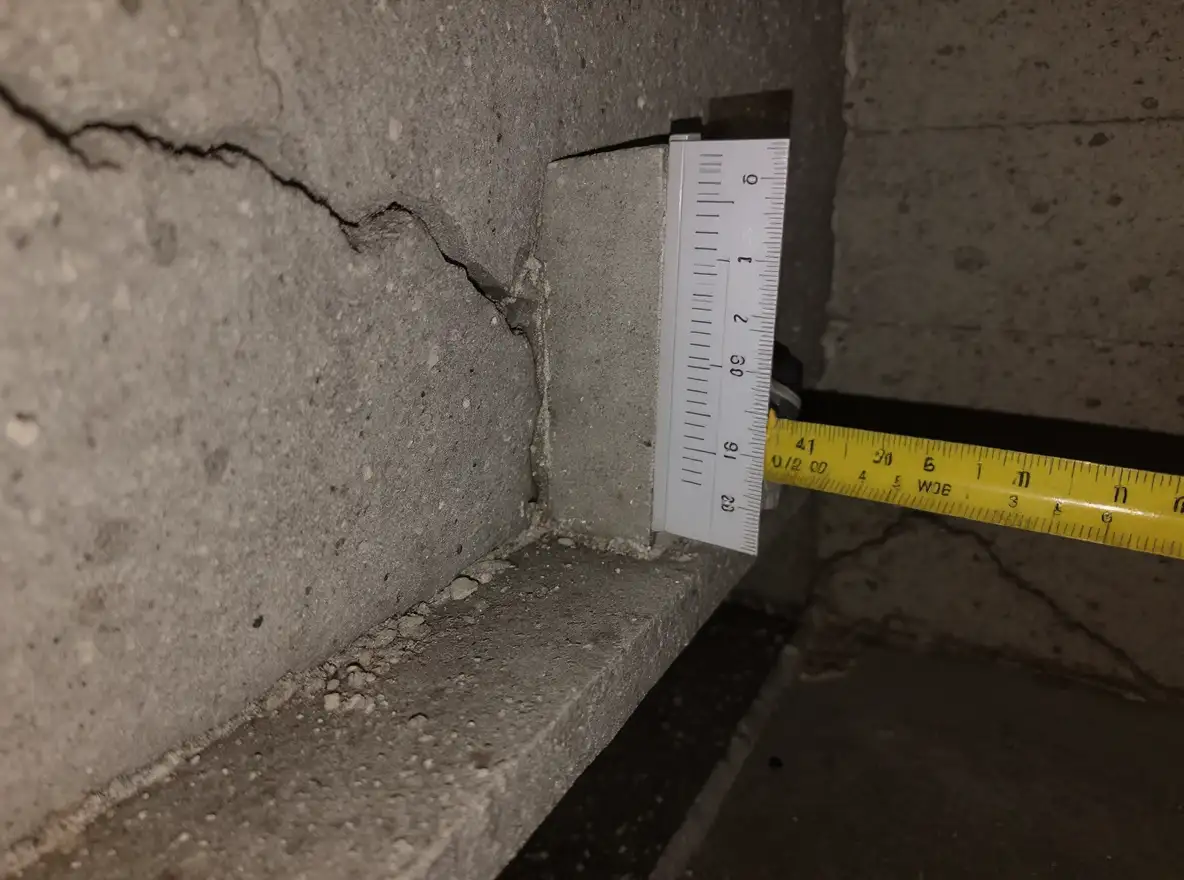
Effective crack monitoring requires a consistent baseline and regular documentation at the same intervals. The goal is to determine whether a crack is stable (not changing), slow-progressing (growing gradually with seasonal cycles), or actively moving (growing measurably between observations). This determination drives the decision about whether to continue monitoring, schedule an evaluation, or proceed with repair.
Mark crack endpoints with a short pencil line perpendicular to the crack direction, and write the date next to the mark. If the crack extends past your mark at the next observation, it is growing. For width monitoring, use a crack width gauge (available at hardware stores for under $10) or photograph the crack next to a ruler. Crack monitors — simple plastic gauges that straddle the crack and measure both width change and lateral displacement — cost $15 to $30 each and provide more precise readings.
Monitor quarterly, aligned with Kansas City's and Des Moines' seasonal cycle. Check in March (end of freeze-thaw), June (peak spring moisture), September (end of summer drought), and December (pre-freeze). This schedule captures the full range of soil movement through one annual cycle. Twelve months of stable readings through all four seasons provides reasonable confidence that settlement has reached equilibrium.
When Should You Call a Professional About Foundation Cracks?
Call a structural engineer or foundation professional when any of these conditions exist: cracks wider than 1/4 inch, any horizontal crack in a basement wall, visible displacement across a crack, cracks that are actively growing between quarterly observations, or multiple crack types appearing simultaneously. A single hairline vertical crack in poured concrete is monitoring territory. Multiple cracks of different types appearing across the home — stair-step in the basement, diagonal at windows, plus sticking doors upstairs — is a pattern that requires professional interpretation.
A structural engineer provides an independent diagnosis not tied to selling you a repair. Their evaluation produces a report you can use to evaluate contractor proposals, support insurance claims, and establish the scope of any necessary repair — see the cost page for current engineer evaluation fee ranges. For information on repair costs, see the cost and economics page.
What Other Symptoms Appear Alongside Foundation Cracks?
Foundation cracks rarely exist in isolation — the structural movement that produces cracks also produces secondary symptoms throughout the home. The same differential settlement that creates stair-step cracks in the basement will rack door frames on the floor above, creating sticking doors. It will tilt floor joists, creating sloping floors. If the chimney sits on an independent footing, the differential movement may produce visible chimney separation.
Look for these companion symptoms when you find foundation cracks:
- Doors and windows that stick, jam, or won't latch
- Floors that slope or feel uneven underfoot
- Gaps between walls and ceiling or walls and floor trim
- Nail pops in drywall (fasteners pushed out as framing shifts)
- Cracks in interior drywall, especially above door and window frames
- Chimney pulling away from the house
When Do Foundation Cracks Progress Most Rapidly in Kansas City and Des Moines?
Crack progression follows your local soil's seasonal cycle, not a calendar. In Kansas City, the two highest-risk windows are late spring (May-June) when peak rainfall saturates Wymore-Ladoga clay to full expansion and generates maximum lateral pressure, and late summer (August-September) when drought-driven clay contraction pulls support from footings and accelerates settlement. A crack that measured 1/8 inch in March may measure 3/16 inch by September — not from a single event, but from the cumulative effect of two full soil cycles.
In Des Moines, the peak risk window runs from March through June, when spring snowmelt overlaps with the year's heaviest rainfall months. The glacial till's poor drainage means moisture accumulates rather than dispersing, raising water tables and sustaining lateral pressure against basement walls for weeks. Winter adds a secondary threat: the 42-inch frost depth freezes soil against the wall face through December, January, and February, cycling expansion pressure multiple times per week during freeze-thaw events.
The best monitoring windows are the transition months — March-April and September-October — when soil is actively changing moisture state. Setting crack measurements at these four points annually captures the full range of seasonal movement. If your crack grows between any two consecutive readings, you have confirmed active movement, not stable historic settlement. For a complete explanation of how seasonal patterns differ between the two metros, see the soil mechanics page.
Which Repair Methods Address Foundation Cracks?
The repair method depends on what type of crack you have and what is causing it — the crack itself is a symptom, not the repair target. Settlement driving stair-step and diagonal cracks requires stabilizing the footing, typically with push piers (for heavier existing homes) or helical piers (for lighter structures or new construction). Lateral pressure driving horizontal cracks requires wall stabilization with wall anchors or carbon fiber straps. Non-structural vertical cracks in poured concrete can be sealed with epoxy or polyurethane crack injection.
Crack injection alone does not solve settlement or lateral pressure — it treats the symptom without addressing the cause. If the underlying soil movement continues, the sealed crack will re-open or new cracks will form nearby. A structural engineer's evaluation identifies the failure mode; the repair method follows from the diagnosis, not from the crack type alone. For current repair cost ranges in Kansas City and Des Moines, see the cost and economics page.
How Do Foundation Crack Patterns Differ Between Kansas City and Des Moines?
Kansas City and Des Moines produce different dominant crack types because their soil conditions generate different failure mechanisms. Identifying which metro pattern matches what you're seeing narrows down the probable cause and the appropriate repair approach.
In Kansas City, stair-step and diagonal cracks dominate. Wymore-Ladoga clay contracts dramatically during summer drought, creating voids beneath footings and driving differential settlement. The block basement walls in KC's 1940s-60s housing stock fail at mortar joints under this differential loading, producing stair-step crack patterns. Diagonal cracks from window corners follow in poured concrete homes from the same era. The Kansas City crack is predominantly a settlement-driven crack from below.
In Des Moines, horizontal cracks and wall bowing dominate. Glacial till's persistent hydrostatic pressure pushes laterally against basement walls year-round. The crack runs horizontally at mid-wall height — where bending stress is greatest — rather than diagonally or through mortar joints. The Des Moines crack is predominantly a lateral-pressure crack from the outside. Stair-step cracks do appear in Des Moines' older block-wall housing stock (Beaverdale, Sherman Hill), but horizontal cracks from hydrostatic pressure are the metro's most common structural symptom.
The geographic distinction affects repair selection directly. KC's settlement-driven cracks require addressing the failing soil support (piering). Des Moines' lateral-pressure cracks require addressing the wall's resistance to that pressure (anchors or carbon fiber). A horizontal crack in a Des Moines basement needs different evaluation criteria than a diagonal crack in a Kansas City basement — even if they look superficially similar.
What Can a Homeowner Do About Foundation Cracks — and What Requires a Professional?
The honest answer is: homeowners can do excellent diagnostic work and ongoing monitoring, but structural repair requires professional assessment and professional installation. Here is the specific breakdown:
What homeowners can and should do
- Measure and document. Photograph cracks with a ruler for scale. Mark endpoints with dated pencil lines. Record widths at multiple points using a crack width gauge ($10 at hardware stores). This creates the progression data that determines whether intervention is needed.
- Install crack monitors. $15-$30 plastic gauges straddle a crack and measure both width change and lateral displacement between observations. More precise than pencil marks for active cracks.
- Seal hairline cracks in poured concrete walls that are confirmed stable (no growth over four seasons, no displacement). DIY polyurethane crack filler or hydraulic cement seals moisture pathways without addressing structural issues. Do not seal cracks that are actively growing — the seal will fail and you'll lose your growth baseline.
- Correct drainage around the foundation. Extending downspouts, regrading soil away from the house, and clearing gutters reduces the moisture load driving crack formation. This is the highest-value DIY action for KC's shrink-swell soil.
What requires professional assessment
- Any horizontal crack in a basement wall — regardless of width
- Any crack wider than 1/4 inch
- Any crack showing lateral displacement across the face
- Any crack that has grown between observations
- Multiple crack types appearing simultaneously (pattern of movement)
What requires professional repair
All structural repair — piering, wall anchors, carbon fiber, crack injection on structural cracks — requires professional installation. The equipment involved (hydraulic rams, torque motors, epoxy injection systems) and the load calculations needed to specify pier depth, anchor spacing, and strap placement are not homeowner-scale work. DIY foundation repair attempts typically cause more harm than good by delaying legitimate diagnosis or creating false confidence.
Frequently Asked Questions About Foundation Cracks
- How do I know if a crack in my foundation is serious?
- Crack width is the primary severity indicator. Hairline cracks under 1/16 inch are typically cosmetic. Cracks between 1/16 and 1/4 inch warrant monitoring. Cracks wider than 1/4 inch, or any horizontal crack in a basement wall, indicate active structural movement and require professional evaluation.
- Do foundation problems get worse over time?
- Foundation problems are progressive. Soil conditions that caused initial movement continue acting on your foundation every season. A crack that's 1/8 inch this year may be 1/4 inch next year as the shrink-swell cycle or hydrostatic pressure continues. Early intervention is consistently less expensive than waiting.
- What is the shrink-swell cycle and how does it damage foundations?
- The shrink-swell cycle occurs when clay soil absorbs water and expands (exerting lateral pressure on foundation walls), then dries and contracts (pulling support away from footings). In Kansas City, this cycle is driven by seasonal rainfall variation — from 5.7 inches in May to 1.5 inches in January — creating foundation-damaging soil movement every year.
- Does Kansas City have clay soil?
- Kansas City sits on the Wymore-Ladoga soil complex, which contains 60-80% clay and carries a 'very high' shrink-swell rating from the USDA. This is among the most expansive clay soil in the Midwest, classified as Hydrologic Soil Group D — the highest runoff, lowest infiltration category.
- What is the best foundation repair method?
- There is no single best method — the right repair depends on the specific failure mode. Settlement from soil compression requires piering (push or helical). Bowing walls from lateral pressure require wall anchors or carbon fiber straps. Sinking slabs require polyjacking. A qualified engineer diagnoses the failure mode first, then recommends the appropriate repair.