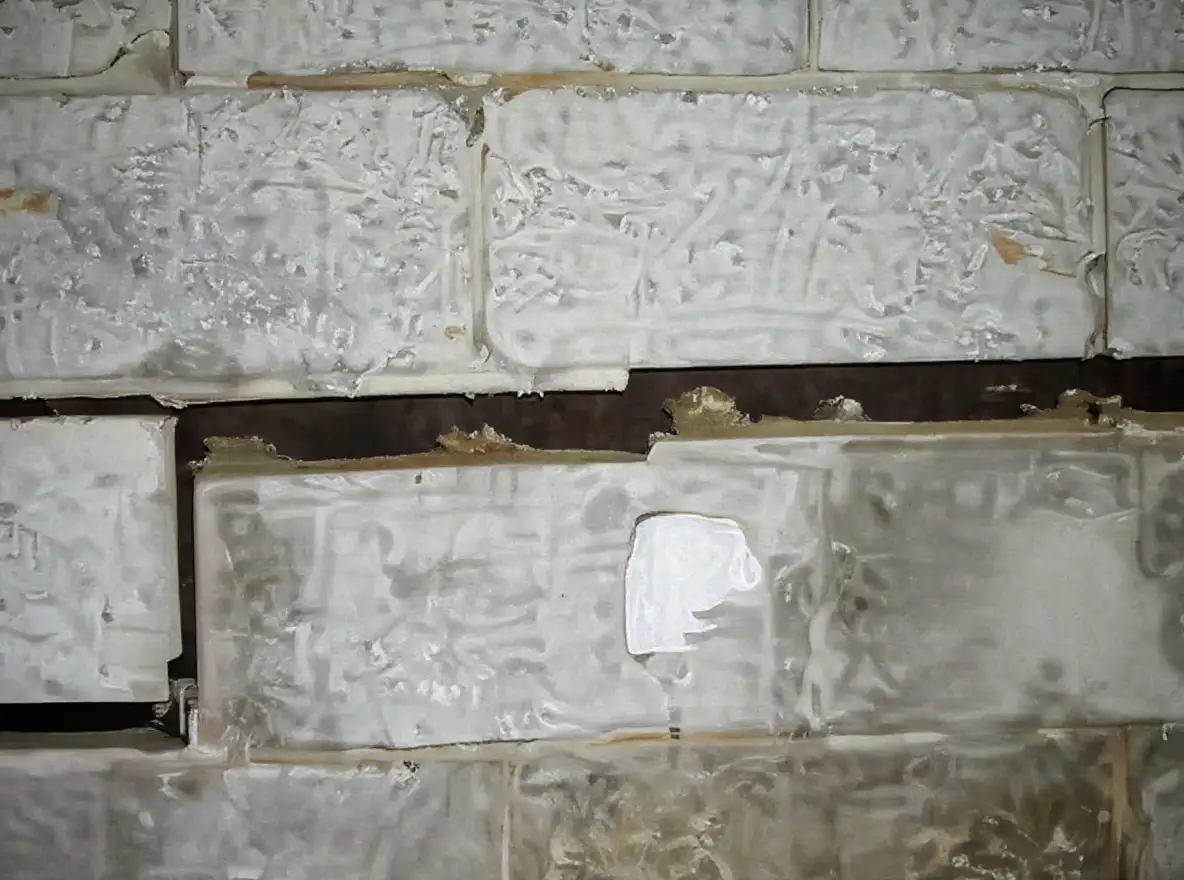
Horizontal cracks in basement walls are the most structurally serious crack type a homeowner can encounter. A horizontal crack running across a basement wall indicates that lateral earth pressure from soil outside the wall has exceeded the wall's tensile capacity. The wall is being pushed inward. Unlike vertical or stair-step cracks, which may stabilize on their own, horizontal cracks represent an ongoing force that acts on the wall every time the soil becomes saturated, every time it freezes, and every time heavy equipment or vehicle traffic loads the ground above.
Any horizontal crack in a basement wall requires professional evaluation regardless of width.
A horizontal crack in a basement wall is the most structurally serious crack type a homeowner can encounter. The wall is being pushed inward by lateral soil pressure, and that force does not stop on its own.A hairline horizontal crack still confirms that the wall's structural capacity has been reached at that point. The crack will not heal, the soil pressure will not decrease, and each subsequent loading cycle pushes the wall slightly further inward. Early evaluation and stabilization prevent a problem that might be addressed with carbon fiber reinforcement or wall anchors from progressing to the point where full wall replacement becomes the only option.
What Does a Horizontal Crack Look Like in a Basement?
A horizontal crack runs straight across a basement wall, roughly parallel to the floor, and typically appears between one-third and one-half of the way up the wall height from the floor. This location corresponds to the point of maximum bending stress in a wall that is fixed at the bottom (by the footing) and supported at the top (by the floor framing). The mid-wall fracture line is where the inward bending force creates the greatest tensile stress on the interior face of the wall.
The crack extends across most or all of the wall length, often running the full span between corners. Lateral earth pressure acts across the entire buried face of the wall, not at a single point. The resulting crack reflects that distributed load by extending across the full width. Short horizontal cracks that span only a few feet are less common and may indicate a localized stress concentration rather than general lateral pressure.
Look for wall inward displacement — a visible bow where the wall has moved inward from its original plane. Stand at one end of the wall and sight along its length. A bowing wall will curve inward at the mid-height point, with the maximum deflection at the location of the horizontal crack. Wall deflection measurement can be done with a long straightedge or a taut string line held against the wall at the top and bottom. Measure the gap between the string and the wall surface at the crack location. Any measurable inward displacement confirms active structural movement.
Water seepage along the crack line is common because the crack creates a direct pathway for moisture to penetrate the wall. You may see mineral deposits (white efflorescence) along the crack, staining below the crack, or active dripping during wet weather. The water intrusion is a secondary problem — the structural wall capacity issue is primary — but the moisture confirms that hydrostatic soil loading is present on the exterior face.
Why Do Horizontal Cracks Form in Basement Walls?
Horizontal cracks form when lateral earth pressure pushing against the outside of the basement wall exceeds the wall's ability to resist bending. Soil exerts horizontal force against any buried vertical surface. The magnitude of that force depends on the soil type, moisture content, depth of burial, and any surcharge loads (driveways, patios, vehicles) on the surface above. When the accumulated lateral force creates bending stress that exceeds the tensile strength of the wall material, the wall cracks horizontally at the point of maximum stress.
Hydrostatic soil loading is the primary driver in regions with clay-rich or water-retentive soils. Des Moines glacial till creates persistent hydrostatic pressure against basement walls because the dense, clay-rich till retains water long after rainfall stops. Horizontal cracks are more prevalent in the Des Moines metro than in Kansas City's shrink-swell environment because the pressure is sustained rather than cyclical. The 42-inch frost depth in central Iowa adds freeze-thaw pressure cycles on top of the baseline hydrostatic load, compounding the lateral force during winter months.
Frost expansion multiplies lateral pressure during winter. When water-saturated soil freezes, it expands by approximately nine percent. In the frost zone adjacent to a basement wall, this expansion pushes directly against the wall surface. The freeze-thaw cycling that occurs throughout a Midwest winter — freezing at night, thawing during the day, refreezing — applies repeated pressure impulses that fatigue the wall material over successive seasons. For a detailed explanation of how soil types and frost depth create foundation stress in Kansas City and Des Moines, see the soil science page.
Surcharge loading from heavy objects, vehicles, or structures near the foundation wall increases the lateral pressure at depth. A concrete driveway slab running alongside the basement wall adds sustained weight to the soil above the wall's buried face. Vehicles parked close to the house add dynamic surcharge loading. Heavy landscaping equipment operated near the foundation applies impulse loads. Each of these factors increases the lateral earth pressure the wall must resist, and none of them were necessarily accounted for in the original wall design.
How Serious Is a Horizontal Crack in a Basement Wall?
Every horizontal crack in a basement wall is structurally significant — the severity classification is "severe" regardless of crack width because the crack confirms the wall has exceeded its structural capacity at that point. The question with horizontal cracks is not "is this structural?" — it always is. The question is how far the wall has deflected inward and whether stabilization can preserve the existing wall or whether replacement is necessary.
Wall Deflection Severity Scale
- Crack present, no measurable deflection: The wall has cracked but has not yet bowed inward. This is the earliest stage and the point at which stabilization is most effective and least expensive. Carbon fiber straps or steel reinforcement can prevent further movement.
- Under 1 inch of inward deflection: The wall has begun to bow. Wall anchors or carbon fiber reinforcement can stabilize the wall and, in some cases, gradually straighten it over time as anchors are periodically tightened.
- 1 to 2 inches of inward deflection: Significant basement wall buckling has occurred. Wall anchors may still be viable, but the structural engineer's assessment will determine whether the wall can be saved or whether replacement is necessary.
- Over 2 inches of inward deflection: The wall has displaced substantially from its original plane. Full wall replacement is frequently recommended at this stage because the wall has lost too much structural integrity to be reliably stabilized in place.
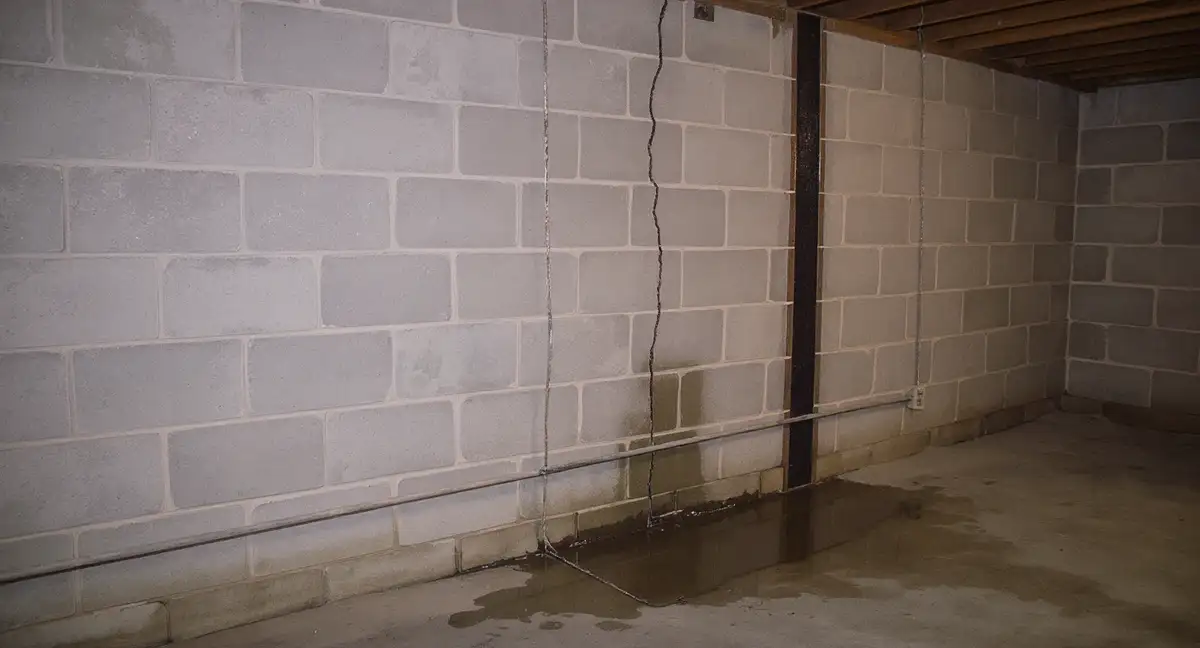
The progression rate of horizontal cracks follows a predictable pattern tied to seasonal soil conditions. The wall deflects the most during peak lateral pressure periods — late spring when soil moisture peaks and late winter during freeze-thaw cycles. During dry summer months, pressure decreases and movement slows or pauses. Each wet season and each winter adds incremental deflection. Monitoring wall deflection quarterly with a string line measurement allows you to track the progression rate and make informed decisions about timing.
Horizontal cracks at the mortar joint just below grade level are particularly common in block walls. This location corresponds to the transition between backfilled soil and undisturbed soil, where lateral pressure concentrates. The mortar joint is the weakest point in a block wall's cross-section, and the below-grade location puts it at the point of highest soil pressure. Block walls are more vulnerable to horizontal cracking than poured concrete walls because they lack continuous tensile reinforcement across the mortar joints.
What Other Symptoms Appear Alongside Horizontal Cracks?
Horizontal cracks are part of a broader pattern of lateral pressure symptoms that typically appear together as the wall deflects inward. Because the wall is being pushed from outside, the symptoms concentrate along the affected wall and in the floor area immediately inside it. Looking for related symptoms helps confirm the lateral pressure diagnosis and assess how far the movement has progressed.
Watch for these companion symptoms when horizontal cracks are present:
- Wall bowing visible when sighting along the wall length — the mid-height area curves inward while the top and bottom remain closer to the original plane
- Floor slab cracking near the base of the affected wall — as the wall pushes inward, it can tilt the footing and crack the adjacent slab
- Water seepage along the horizontal crack line, often with white mineral deposits (efflorescence) marking the moisture path
- Doors and windows near the affected wall sticking — as the wall moves inward, it distorts the framing connections above
- Vertical cracks at the corners where the bowing wall meets perpendicular walls — the corner connection cannot accommodate the inward movement
- Floor sloping toward the affected wall — if the footing tilts under the inward pressure, the floor joists bearing on that wall tilt with it
Exterior symptoms are equally telling — look for the soil pulling away from the foundation wall during dry periods. A gap between the soil surface and the wall exterior indicates the soil is cycling between expansion (pushing the wall) and contraction (pulling away). This visible gap confirms the shrink-swell or freeze-thaw mechanism that is driving the lateral pressure. Filling this gap with rigid material is counterproductive — it creates a wedge that increases pressure during the next expansion cycle.
How Urgently Should You Respond to a Horizontal Basement Crack?
Horizontal cracks warrant faster professional evaluation than other crack types because the underlying force — lateral soil pressure — is persistent and cumulative. While the diagnostic steps below are valuable for documentation, do not delay professional evaluation while completing a full monitoring cycle. The monitoring data you collect before the evaluation helps the structural engineer, but the evaluation itself should not wait for twelve months of quarterly readings.
Step 1: Measure and Document Wall Deflection
Stretch a taut string line from one end of the wall to the other at the height of the horizontal crack. Measure the gap between the string and the wall surface at the point of maximum bow. Record this measurement with the date. Photograph the measurement setup. This wall deflection measurement is the single most important data point for the structural engineer's evaluation and for tracking whether the wall continues to move before repair is completed.
Step 2: Document the Crack and Related Symptoms
Photograph the full length of the crack with a ruler for scale, and note its height above the floor slab. Photograph any water seepage, efflorescence, or staining along the crack. Walk through the home and document any related symptoms — sticking doors, floor slope, drywall cracks, corner separations. This documentation creates a complete picture that helps the evaluating engineer understand the full scope of movement.
Step 3: Evaluate Exterior Conditions
Check the exterior grading, drainage, and surcharge loading adjacent to the affected wall. Is the soil graded toward the foundation rather than away from it? Are downspouts discharging near the wall? Is there a driveway, patio, or heavy landscaping element loading the soil above the wall? Are vehicles routinely parked close to the house on that side? Each of these conditions increases lateral pressure and may be correctable. Addressing drainage and grading issues reduces the ongoing pressure even before structural repair is completed.
Step 4: Schedule a Structural Engineer Evaluation
A structural engineer will measure wall deflection precisely, assess the wall's remaining capacity, and recommend the appropriate stabilization method. The evaluation produces a written report that specifies whether the wall can be stabilized in place (with carbon fiber, steel beams, or wall anchors) or whether it has deflected beyond the point where in-place stabilization is reliable and requires replacement. For information on evaluation fees and repair cost ranges, see the cost and economics page.
Horizontal cracks warrant faster professional evaluation than other crack types. Measure wall deflection with a string line, document the crack and related symptoms, evaluate exterior drainage and surcharge loading, and schedule a structural engineer evaluation promptly — do not wait for a full year of monitoring before acting.
When Is a Horizontal Basement Crack Under Peak Stress in Midwest Homes?
Horizontal cracks are uniquely dangerous because the lateral forces driving them do not follow a single seasonal peak — they come in two waves with different mechanisms. In Kansas City, the spring rainfall peak (May-June) saturates the Wymore-Ladoga clay, generating maximum expansion pressure against the wall. The winter freeze-thaw cycle adds a second pressure wave: each time saturated soil adjacent to the wall freezes, it expands roughly nine percent by volume, pushing directly against the wall face. A wall that deflected 3/4 inch inward last spring may deflect to 7/8 inch by February.
Des Moines presents a more sustained threat than Kansas City because glacial till retains water through the entire March-June period. Where Kansas City foundations experience discrete pressure spikes tied to individual rainfall events, Des Moines foundations face weeks of elevated hydrostatic pressure that depresses more slowly. The peak lateral pressure in a Des Moines basement typically occurs in late April or early May — after the snowmelt has saturated the till but before summer evaporation begins reducing the water table.
The safest monitoring schedule for a horizontal crack is four readings per year: late February (post-winter freeze), late May (peak saturation), late August (maximum contraction in KC / recovery in DM), and late November (pre-freeze baseline). Wall deflection measured with a taut string line at the crack height is more informative than width measurements alone — even a 1/8-inch increase in inward bow over one season indicates the wall is actively moving under sustained lateral force.
Which Repair Methods Stabilize Walls With Horizontal Cracks?
Horizontal cracks with inward wall bowing are addressed by wall stabilization systems designed specifically for lateral earth pressure. For walls that have deflected less than two inches inward, carbon fiber straps bonded vertically to the interior wall surface prevent further inward movement. The straps are unidirectional high-tensile fiber that arrests bowing without requiring exterior excavation. For walls needing correction rather than just stabilization, or for deflection greater than two inches, steel wall anchors connect the wall to stable soil 10-15 feet out from the foundation and can be periodically tightened to straighten the wall over time.
When a horizontal crack has allowed the wall to deflect beyond what anchors or straps can address, full wall replacement may be the only viable option. This involves temporarily supporting the structure, removing the failed wall, and pouring a new reinforced concrete wall. The specific threshold — repair vs. replace — depends on the extent of deflection, the wall material (block vs. poured concrete), and the structural engineer's assessment of remaining wall capacity. For cost data on each of these repair approaches, see the cost and economics page.
How Horizontal Cracks Differ Between Kansas City and Des Moines Foundations
Horizontal cracks occur in both Kansas City and Des Moines, but Des Moines has a significantly higher prevalence — and the driving forces and seasonal patterns differ between the two metros.
In Des Moines, horizontal cracks are the metro's defining foundation failure symptom. Glacial till's persistent hydrostatic pressure — sustained lateral force from water trapped in poorly draining soil — pushes against basement walls year-round. The force concentrates at mid-wall height where bending stress is greatest, producing horizontal fractures that extend across the full wall width. Des Moines' 42-inch frost depth adds freeze-thaw pressure cycles on top of the baseline hydrostatic load, driving the wall further inward during each winter. Horizontal cracks in Des Moines are most active during March-June (spring saturation peak) and may show measurable wall deflection change within a single wet season.
In Kansas City, horizontal cracks are less common but still occur — typically where drainage problems or creek proximity creates sustained hydrostatic pressure that KC's predominantly shrink-swell soil wouldn't generate on its own. KC homes near drainages, streams, or with chronic water management issues see horizontal cracking from lateral pressure. KC's dramatic seasonal swings also drive extreme clay expansion in May-June that can generate lateral pressure surges against basement walls — horizontal cracks in KC homes typically worsen during peak spring saturation.
The shared rule across both metros: any horizontal crack in any basement wall requires professional evaluation regardless of width. The force that caused the crack continues acting on the wall whether the crack is 1/16 inch or 1 inch wide.
How to Track Horizontal Crack Progression and Wall Deflection
For horizontal cracks, wall deflection measurement is more important than crack width measurement. The crack confirms lateral pressure has been reached; wall deflection tells you how far the wall has moved and determines which stabilization method is appropriate.
Measure wall deflection with a taut string line. Stretch a string from one end of the affected wall to the other at the height of the horizontal crack, holding the string against the wall at each end. Measure the gap between the string and the wall surface at the point of maximum bow. Record this distance in millimeters for precision. Do this at the first observation to establish baseline, then repeat quarterly.
Record both the deflection measurement and the date. Compare each reading to the previous one. Any increase in deflection between observations — even 1/8 inch — confirms the wall is still actively moving under lateral pressure. A wall that has not changed deflection between two consecutive seasonal measurements (particularly between spring peak and fall low-point) may be approaching equilibrium, though this requires professional confirmation.
Photograph with a straightedge or level placed against the wall to capture the bow visually. Unlike stair-step crack photos, horizontal crack documentation benefits from showing the full wall length — the bow may not be obvious at close range but is visible when the photo captures the entire wall.
Monitor in Des Moines: late April (peak saturation) and late October (pre-freeze baseline). In Kansas City: late May-early June (peak expansion) and late September (post-drought, pre-rehydration). Any increase in deflection during these observation windows indicates active progressive movement.
Horizontal Cracks: What Homeowners Can Do vs. What Requires a Professional
Horizontal cracks require faster professional evaluation than other crack types — the underlying lateral force does not stop, and wall deflection compounds with every wet season. The DIY role is primarily documentation and drainage management, not repair.
What homeowners can do
- Measure and document wall deflection using the string-line method described above. Create a dated deflection record.
- Photograph the full wall length quarterly to capture bow progression visually.
- Check and improve exterior drainage. Removing soil that grades toward the foundation, extending downspouts, and eliminating surface water pooling reduces the hydrostatic pressure driving the crack. This is the only DIY action that directly addresses the cause rather than documenting the symptom.
- Do NOT push or brace the wall with temporary supports. The forces involved are substantial — thousands of pounds per linear foot of wall — and improvised bracing can fail suddenly or create new structural stress concentration points.
Why professional evaluation should not wait for a "monitoring cycle"
Unlike other crack types where a full annual monitoring cycle before evaluation is reasonable, horizontal cracks warrant professional evaluation as soon as they're discovered. The force that caused the crack is continuous — not seasonal — and each wet period pushes the wall slightly further inward. Getting a baseline deflection measurement from a professional early allows you to track progression with accurate data, and it identifies whether you're in the early stage where carbon fiber straps are effective or whether the wall has already moved past that window.
Frequently Asked Questions About Horizontal Cracks
- What is hydrostatic pressure and how does it affect basement walls?
- Hydrostatic pressure is the force exerted by water saturating the soil surrounding your basement walls. When the water table rises or heavy rainfall saturates the ground, water-laden soil pushes inward against the wall with increasing force at greater depths. This pressure is constant — unlike the intermittent force from shrink-swell clay — and acts on the full height of the wall below grade. Basement walls are designed to resist a certain amount of lateral earth pressure, but sustained hydrostatic loading can exceed that design limit, producing horizontal cracks at the mid-wall stress point.
- Do foundation problems get worse over time?
- Foundation problems are progressive in nearly all cases. The soil conditions that caused initial wall movement continue acting on the foundation every season. A basement wall that has deflected half an inch inward this year will continue deflecting with each wet season and freeze-thaw cycle. Lateral pressure does not reverse itself — once a wall begins bowing, each subsequent loading cycle pushes it slightly further. Early stabilization consistently costs less than waiting until the wall requires full replacement.
- What type of soil causes foundation problems in Des Moines?
- Des Moines sits on glacial till deposited during the Wisconsin glaciation — a dense, clay-rich mixture of fine-grained soil and glacial debris. This till retains water effectively, creating persistent hydrostatic pressure against basement walls even during periods without active rainfall. The clay fraction of the till also exhibits moderate shrink-swell behavior, though the dominant foundation stress in the Des Moines metro comes from sustained lateral pressure rather than the dramatic shrink-swell cycling seen in Kansas City's Wymore-Ladoga clay.
- What foundation problems are most common in Ankeny and West Des Moines?
- Ankeny and West Des Moines experience high rates of basement wall bowing and horizontal cracking due to the glacial till soil profile throughout the northern Des Moines metro. Newer subdivisions built on previously undeveloped agricultural land encounter settlement as the disturbed soil consolidates under building loads. Horizontal cracks at mid-wall height are the most frequently reported structural symptom, followed by floor slab cracking from hydrostatic uplift pressure and efflorescence staining from persistent moisture migration through basement walls.
- Is foundation repair worth the cost?
- Foundation repair protects the largest financial asset most families own. Unrepaired foundation problems reduce home value by 10 to 15 percent on average, and some buyers will not purchase a home with known unresolved structural issues at any price. Beyond resale, progressive foundation failure leads to secondary damage — plumbing breaks, HVAC duct separation, water intrusion — that compounds the total cost of inaction. For specific cost ranges and economic analysis, see the cost and economics page.